
It is not uncommon today to find critique practices that proceed as though evaluation can meaningfully precede criteria. A work is shown, reactions are offered, preferences are circulated, and the resulting exchange is treated as though it were pedagogically informative. Yet much of what passes for critique (in its common open-ended form) is better understood not as rigorous educational critique than as taste-reporting: a record of what particular viewers happen to like, dislike, prefer, or associate with. I would absolutely argue that such exercises indeed have social value and, in some contexts, even commercial value, but their instructional value is often limited when untethered to criteria. Where no clear criteria or goal of appropriate resolution has been established, there is no sufficiently stable basis on which to judge whether a recommendation constitutes progress, regression, or simple diversion.
This is one reason I do not place much pedagogical confidence in what might be called cold critique: open-ended, non-specific evaluation offered in the absence of explicit goals, defined criteria, or a shared standard of success. Under such conditions, feedback tends to drift into personal opinion. What one participant calls “fresh,” another calls “unfinished”; what one sees as “precise,” another sees as “mindless”; what one praises as “loose,” another dismisses as “haphazard.” None of these judgments is necessarily meaningless or without value, but neither are they in themselves consistently educational. Without a sufficiently defined and shared target, critique cannot function reliably as a diagnostic tool. It cannot tell us with much confidence whether a proposed change moves the learner toward a desired result, away from it, or merely sidetracks the learner into another person’s preference structure.
The problem is not simply one of disagreement. It is often also structural. In many cases, what appears to be a technique problem is better understood as an upstream problem of goal specification. This is especially evident in representational art, where a learner may feel strongly drawn to a certain aesthetic outcome without yet being able to define it clearly enough to organize practice around it. In one of my recent roundtable discussions, this problem became strikingly visible. A participant attempted to describe a desired result through a chain of partially compatible descriptors: “loose,” “loosely realistic,” “somewhat impressionistic,” “visible brushstrokes,” “high chroma,” “full range of values,” and yet “not to the point where it’s unrealistic.” The issue is not that these terms are empty, but that they remain too fluid and, in places, contradictory, to function as an operational target.
This matters because effective practice depends on more than aspirations and effort alone. At a minimum, it requires effort organized toward a clearly identified goal. That goal need not be fully elaborated at the outset; indeed, in art it rarely is. A learner may begin with a broad orientation rather than a tightly specified endpoint: to work representationally, to make more deliberate marks, to move away from a graphic handling toward a more painterly one. Such broad aims can justify broad foundational training. But as instruction becomes more specific, procedural, and evaluative, productive practice requires the target to be defined clearly enough (and shared clearly enough) to make recommendations meaningfully assessable.
The central failure mode, then, is a mismatch between the nature and level of specificity of the advice offered and the degree to which the goal has been clearly defined and shared. Broad goals can support broad training, while narrower advice tends to require clearer target-definition. When that relationship breaks down, feedback becomes significantly less diagnostic. A learner is told to use a larger brush, to work faster, to paint more generally, to avoid linework, to adopt a different medium, or to emulate some admired painterly precedent. Any of these may be sensible under the right conditions. But without a sufficiently resolved and shared end state, their pedagogical status remains indeterminate. They are not necessarily wrong; they are not yet evaluable in a pedagogically meaningful way.
Issues of target-definition are also exacerbated by the fact that the most useful answers in a pedagogical sense tend to be the least welcome in the hunt for feedback. Most seem to want the quick route, the actionable trick, the three steps to looseness, or the five-minute route to a new style. People tend to prefer the “shortcut” to the “hard answer,” the “cliff notes” to the novel, the compressed simplification to the slower work of understanding. But in situations of underdefined intention, the hard answer is usually the most useful one: not “how do I do this?” but “what, precisely enough to evaluate and share, am I trying to do?”
One reason this work is so difficult is that artistic intention is often experienced before it is operationalized. What the learner wants may exist in memory not as a blueprint but as something closer to a dream: affectively vivid, selectively detailed, yet structurally unstable. This can be seen in the imprecision of long-term memory and in the familiar problem of a desired image being too conceptually fluid to be manifested as one might hope. That helps explain why the criteria in such conversations can become contradictory. The learner is not insincere. On the contrary, he or she may have a very real sense of attraction or dissatisfaction. But felt direction is not the same as usable specification. One may recognize approximations, reject alternatives, and still remain unable to state the conditions under which success would count as success.
This essay argues that a number of developmental problems in art education may be better understood as problems of target definition rather than defects of technique or drive. More specifically, it argues that critique and instruction become most educationally reliable when their specificity serves the learner’s goal, when that goal has been made sufficiently explicit and shareable to support guidance, and when the resolution of the goal and the guidance align properly. Without that alignment, feedback drifts into preference, methods drift away from purpose, and practice loses much of its diagnostic force. The issue, then, is not whether exploration has a place in art-making. It clearly does. The issue is that exploration, too, must be framed. Where goals are broad, productive exploration may be broad as well. Where goals become narrow, broad exploration often yields relatively little in their service. In this sense, one of the most important steps to take to address an artistic impasse is not the acquisition of a new technique, but the clarification of the destination toward which the technique is supposed to move.
From Technique Problem to Problem of Specification
What often appears in art discourse as a problem of technique is, in many cases, a difficulty located elsewhere. The learner cannot achieve the desired result and can describe it only in broad or unstable terms. When that difficulty is brought to peers, a familiar conversation follows. Skilled practitioners begin offering suggestions about brush size, sequencing, medium choice, speed, mark-making, or process. Such advice may be perfectly plausible and still fail to help—not because it is false, but because it is being directed toward a problem whose end state has not yet been sufficiently defined. The difficulty, then, lies less in bad advice or interpersonal disagreement than in a particular class of problem in which the destination itself remains underdetermined.
This is usefully understood as, or highly analogous to, an ill-defined problem. With an ill-defined problem, the target is incompletely or inappropriately specified, the constraints are only partially known, and the criteria for success remain unstable. Under such conditions, methods cannot be selected with the usual degree of rational confidence, because there is no sufficiently clear end against which candidate approaches can be judged. The difficulty, therefore, lies upstream of procedure. One is not yet fully in the domain of problem-solving, because one is still occupied with determining what the problem actually is. Some may object that broad creative exploration has solved such problems for them in the past. At times, that is true in a loose sense: a learner may arrive at something attractive through quasi-unguided experimentation alone. In many such cases, however, what has occurred is not the deliberate realization of a clearly held end, but the discovery of an alternate result that happens to satisfy some vague or partially related preference. There is nothing illegitimate about that. It can be enjoyable, fruitful, and artistically worthwhile. The concern here is narrower. The question is how incoming information can be evaluated effectively before it is absorbed into practice. For that, a more clearly identified target is required.
Alongside the structure of the ill-defined problem, there is often a second issue: the learner may feel a genuine attraction toward a particular aesthetic region while lacking language stable enough to convert that attraction into guidance for practice. This can be described as goal ambiguity. The term overlaps with the logic of the ill-defined problem, but it captures the issue at a narrower level by emphasizing the instability of the intended end itself. At this stage, the goal has psychological presence but little operational clarity. Its boundaries remain broad, fluid, or internally unstable. The artist may offer descriptors, preferences, and reactions, yet these do not fully consolidate into a target capable of organizing decisions, supporting evaluation, or being reliably shared with the person offering instruction.
Both of these concepts naturally lead to the related concept of problem finding. In creative domains, one often has to identify and formulate the problem before meaningful solving can occur. That labor belongs to the practice itself. In art, it frequently involves turning an inchoate preference into a usable objective. “I want something looser,” for example, does very little on its own. Looser in what respect? Relative to what standard? With how much recognizability preserved, and under what evaluative conditions? Until such questions are addressed, the learner continues to seek methods for an effect that has only been vaguely distinguished from adjacent but materially different possibilities.
For this reason, it is useful to distinguish between a felt aim and an operational target. A felt aim is affectively real: the learner senses attraction, dissatisfaction, aspiration, or resistance. An operational target carries a greater degree of structure. It is a goal articulated clearly enough that progress toward it can be observed, compared, judged, and discussed in common by learner, advisor, or instructor. Such a target need not be unreasonably exhaustive, but it must be sufficiently specified to support effective decision-making. At a minimum, it should answer the question: “What would count as movement in the right direction?” Once that threshold is reached, instructional advice becomes evaluable.
Such evaluability depends on criteria. Criteria are what allow critique to function diagnostically rather than merely expressively. They establish the terms under which a change can be judged helpful, harmful, or irrelevant. In their absence, feedback tends to stay mired in personal preference. Once they are in place, it becomes possible to say that a given effort is more or less successful relative to a stated aim, rather than merely more or less pleasing to the person offering the critique. It is here that a familiar objection often appears: “Art is subjective, so how meaningful can objective assessment really be?” The objection matters, but it trades on confusion. The presence of subjective aims or foundations does not preclude objective evaluation. Once a goal and its relevant criteria have been established, judgments can be made relative to that framework with a high degree of rigor. Chess offers a simple analogy. The game is a human construction, and its aims are not metaphysically inevitable; they are simply agreed upon. Yet once those aims and rules are in place, individual moves can be assessed objectively against them. Art differs in important ways, of course, but the underlying point remains: a subjective arena does not preclude objective assessment. It simply requires that the terms of assessment be made explicit.
This is why the absence of a clearly resolved and shared target is so consequential. Without criteria derived from that target, neither learner nor instructor can determine with much confidence whether a proposed intervention is educationally productive. The recurring pedagogical mistake follows from this: art education can often treat underdefined ends as merely underdeveloped means, diagnosing specification failures as technical deficiencies. The learner is assumed to lack execution when the more immediate lack lies in the resolution of the goal itself. Technique still matters, without a doubt, but its usefulness depends on the clarity of the destination it is meant to serve. When failures of target specification are misclassified in this way, instruction becomes nebulous, critique loses diagnostic force, and progress can appear to stall.
Goal Resolution, Instructional Resolution, and Specificity Mismatch
The argument can now be stated more plainly. A path to progress is illuminated only to the extent that the desired destination can be clearly identified. Broad aims can support broad training, but useful guidance, as I’ve stated earlier, depends on more than effort and aspiration alone. It depends on whether the end in view has been defined clearly enough to orient judgment and to make proposed interventions meaningfully assessable. That definition must also be shared. The learner and the source of instruction must be working from a sufficiently common understanding of the goal. Where the destination remains private, unstable, or differently conceived by each party, the path forward becomes difficult to discern, and instruction loses much of its diagnostic force.
This point matters because I believe a good number of educational failures are not due to a lack of sincerity, effort, or even technical capacity, but rather arise from an intended destination that has not been defined clearly enough (or shared clearly enough) to support meaningful guidance. In the roundtable that motivates this essay, the artist could articulate a broad region of concern: representational work, painterly handling, recognizable form, and a move away from graphic tightness, yet the conversation repeatedly drifted toward increasingly specific procedural recommendations before the target had become sufficiently clear and mutually understood to make those recommendations evaluable. Advice began to outrun the shared definition of the goal. What was needed was not necessarily less instruction, but instruction calibrated to a goal that both learner and instructor could identify in common.
For that reason, it is useful to think in terms of at least three levels of goal resolution.
The first is foundational orientation. At this level, the learner has a broad directional commitment but not a narrow communicative or aesthetic destination. Statements such as “I want deliberate control in representational work” or “I want to make marks more intentionally” belong here. These aims are indeed general, but far from useless. They can organize substantial and productive training. Shape control, value structure, edge sensitivity, mark intentionality, visual literacy, and broad compositional strategies all remain appropriate domains of practice at this level. The learner need not yet know exactly what kind of painterly realism, surface quality, or finish structure will eventually be preferred in order to benefit from such training. Broad aims can justify broad foundational work.
The second level is domain-constrained exploration. Here, the learner has moved beyond basic orientation and entered a more bounded search space. The aim is still not fully operational above a certain resolution, but it has acquired a number of recognizable constraints. A statement such as “I want painterly realism with significant abstractions” is more informative than a simple desire to “loosen up,” because it narrows the range of viable outcomes without yet pinning down all relevant variables. Exploration at this level remains legitimate, but it is no longer as open-ended. The learner may test different edge treatments, textural abbreviations, surface-handling strategies, or varying degrees of simplification, but these experiments now occur within a more intelligible region. The task is now a more structured pursuit.
The third level is operational target specification. At this level, the learner can articulate the intended result with sufficient clarity for specific advice to be genuinely testable. The target may now include this subject, this degree of edge hierarchy, this level of abstraction, this threshold of recognition, this kind of brushstroke visibility, and this relation between structure and atmosphere. Once the goal reaches this level of articulation, critique can become far more exacting. Recommendations about brush size, working speed, sequencing, paint handling, medium choice, or degree of blending now have a clear basis for evaluation. They can be judged against something more stable than a broad, general aspiration. At this point, instruction becomes far more diagnostically meaningful.
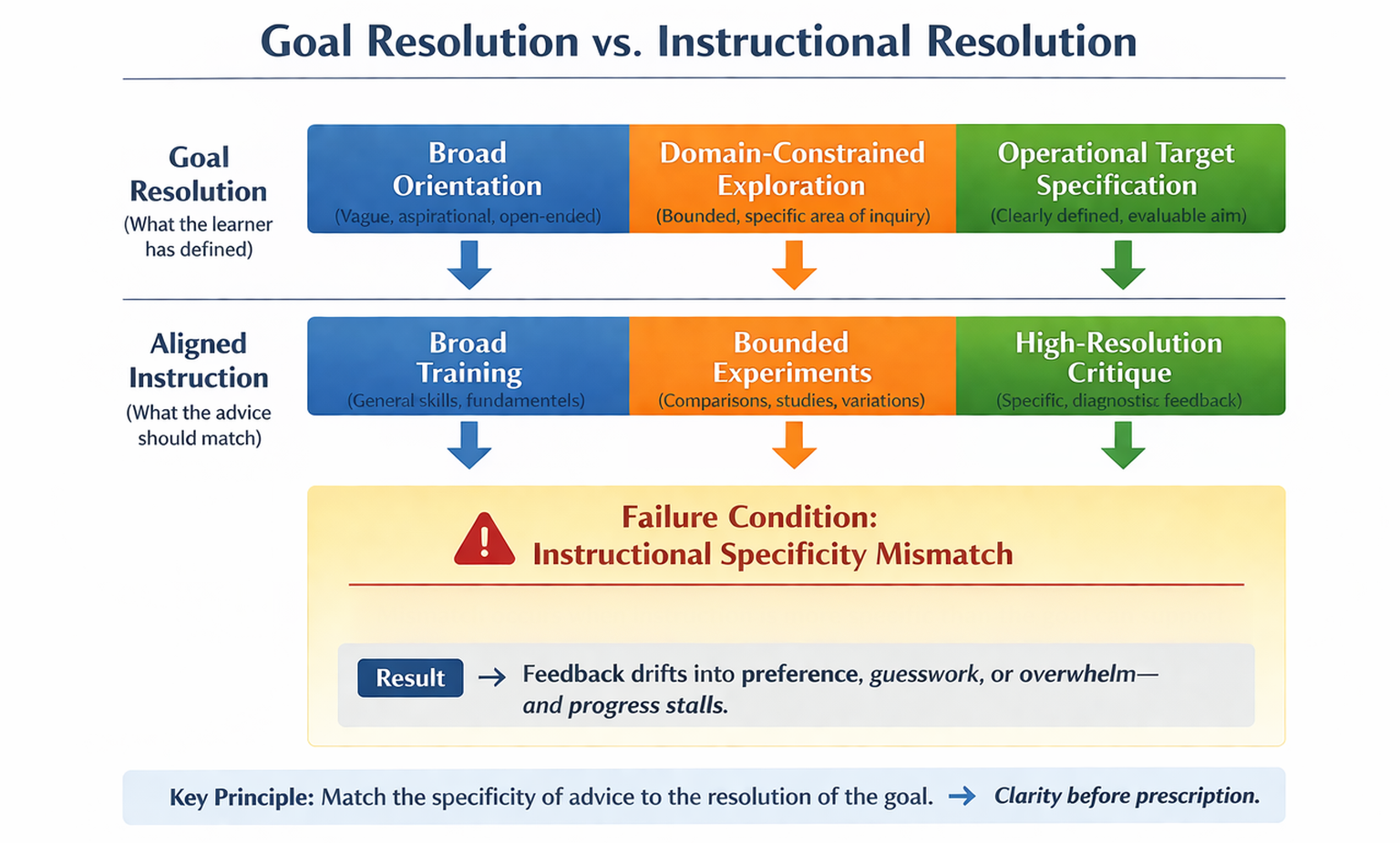
What changes across these levels is not simply the amount of detail the learner can verbalize, but the degree to which the target can be stabilized, made explicit, and made mutually legible. As that happens, different kinds of instructional claims become responsible or irresponsible in turn. At the basic orientation level, it makes sense to recommend general studies in value, shape, and foundational control. At the level of domain-constrained exploration, one can begin to recommend bounded experiments: broader brush handling, reduced edge articulation in selected passages, comparisons across advanced (more complex) exemplars, or exercises that preserve recognizability while shifting handling. At the level of operational target specification, instruction can become tightly coupled to the exact visual problem at hand.
The failure mode at the core of all this may be called instructional specificity mismatch. By this, I mean a condition in which advice is offered at a different level of specificity than the learner’s goal demands, either because the goal remains underdefined or because it has not been sufficiently shared between learner and instructor. A learner working at Level 1 may receive Level 3 advice. Someone still trying to locate the general region of the desired result may be told to alter a highly specific aspect of handling, surface quality, or process. Such advice may be attractive and even effective in certain contexts. Yet, under these conditions, its educational status remains indeterminate because the learner lacks a sufficiently resolved and shared target against which to judge whether the recommendation is corrective, neutral, or redirective. The advice is not necessarily wrong. It is simply premature.
Seen in this way, specificity mismatch becomes a useful lens to understand why otherwise intelligent critiques fail to produce movement. The problem is not always that the critic is wrong, nor that the learner is resistant. Often, the two operate from different understandings of the goal or different assumptions about how fully it has been specified. The critic may speak as though the target were already operationalized, while the learner is still working with something closer to a bounded aspiration. In other cases, both may use the same words while attaching different meanings to them. This mismatch helps explain why a flood of plausible recommendations can leave the learner no closer to clarity. It also helps explain why the “hard answer” in such situations is so often the most useful one: before selecting increasingly narrow means, the learner must determine the goal with greater precision and make that precision sufficiently shareable to support guidance.
The broader pedagogical implication is straightforward. Critique and instruction should be matched not only to the learner’s current level of goal resolution but also to the degree that the goal has been made explicit and mutually understood by everyone involved in the exchange. Foundational aims call for foundational training. Bounded communicative and aesthetic searches call for constrained exploration. Operational targets make room for high-resolution critique. When those levels are aligned, feedback can guide development. When they are not, instruction tends to become less diagnostic, critique drifts toward preference, and technique is asked to solve a problem that properly belongs to specification.
Why People Cannot Easily Say What They Want
At this point, it may be tempting to treat the problem as though it were merely one of carelessness, vagueness, or insufficient thought. But that would miss something important. In many cases, the learner’s difficulty is not a lack of desire, nor even a lack of seriousness, but a difficulty inherent in the structure of intention itself. People often know what they want in a way that is affectively vivid long before they know it in a way that is descriptively stable. They may be drawn toward a result, repelled by nearby alternatives, and highly sensitive to deviations from what “feels right”, yet still remain unable to state clearly what the desired end consists in.
One reason for this is that memory does not function like a blueprint archive. What one retrieves from long-term memory is often partial, selective, reconstructive, and shaped by salience rather than by operational usefulness. The desired image, handling, or aesthetic effect may therefore exist in the mind less as a complete specification than as a vivid but unstable impression. I often explain this to students using the experience of a dream. A dream can feel intensely real while remaining structurally elusive. One may remember its tone, its force, or even a few striking details, yet struggle to reconstruct it in a form stable enough to guide deliberate action. You might find yourself in your Grandmother’s house, but it’s also a department store in which giraffes are purchasing trampolines. It sounds ridiculous, but it can all make perfect sense within the unfolding dream. Artistic intention can often seem to behave in much the same way.
This helps explain why aesthetic desire is so often recognized more readily than described. A learner may know, with some immediacy, that one painting feels closer to the sought result than another. He or she may reject a proposed solution almost instantly, not out of stubbornness, but because it clearly fails to satisfy the felt aim. Yet the same learner may be unable to articulate what the rejected solution lacks, or what the preferred one possesses. Recognition, in other words, may precede description. This is one reason phrases such as “loose but not too loose,” “super realistic but not tight,” or “vibrant but not too saturated” can feel meaningful to the speaker (and even to some readers here) while remaining weak as operational guides. They register a real tension in the desired outcome, but they do not yet resolve it into criteria with high utility in practice.
A further complication is that internal criteria are often only partially coherent. The learner may simultaneously want visible brushwork and a uniform surface, broad simplification without losing details, or an immediately recognizable piece of novelty. None of these pairings is necessarily impossible, but they place competing demands on the work. Until those demands are sorted, weighted, and made explicit, the resulting verbal descriptions can easily sound contradictory. This should not be mistaken for dishonesty or confusion in any trivial sense. It is often the natural consequence of trying to name a complex communicative or aesthetic preference before its internal hierarchy has been clarified.
That is also why learners can often reject false solutions before they can articulate true ones. They may know that a given recommendation is wrong for them, but lack the language to explain why. This asymmetry is important. It suggests that the problem is not simply ignorance, but a mismatch between felt discrimination and verbal specification. The learner can sense that the proposed path leads elsewhere, but cannot yet define the destination clearly enough to redirect the conversation. In such moments, critique can become especially frustrating. The learner appears indecisive or resistant, but may in fact be struggling with a very real, yet still understructured intention. The movement from attraction to articulation, from felt aim to operational target, is itself a developmental task. That movement rarely occurs all at once. It often proceeds through approximation, contrast, revision, and repeated failed attempts at description. What matters pedagogically is not pretending that the desired end is already fully knowable, but recognizing that the learner may be in possession of something real though not yet sufficiently formed: a direction without a map, a destination sensed more clearly than it can be stated.
This is precisely why broad exploratory work can sometimes be very useful. Even when the learner cannot yet specify the destination clearly, exploration remains shaped by attraction, aversion, memory, exemplars, and partially formed criteria. The issue is not whether such exploration should occur, but whether it is being mistaken for something more precise than it is. Exploration can help bring the target into view. It cannot substitute for target-definition indefinitely. At some point, if instruction is to become reliably diagnostic, the learner must begin converting felt preference into shareable criteria.
Toward a Better Model of Critique and Instruction
If a cold critique is limited pedagogically because it offers evaluation without sufficient criteria, then a more useful model must begin by establishing the conditions under which feedback can become diagnostic. The point is not to eliminate critique, nor to sterilize it into a rigid procedure. The point is to give critique a structure capable of serving learning rather than merely circulating preference. What is needed, then, is not less response, but better-conditioned response: feedback calibrated to the learner’s current level of goal definition and capable of being assessed against a shared target.
A more useful process begins by determining the learner’s goal resolution. Before offering advice, one must ask what level of specificity the learner actually possesses. Is the learner operating with a broad orientation, such as a desire for greater control in representational work? Is the learner working within a more bounded yet still exploratory region, such as a balance between descriptive realism and bold abstraction? Or has the learner reached the point of an operational target, where the desired outcome can be described in terms specific enough to support direct, higher-resolution intervention? Until that is established, a critique risks speaking at the wrong resolution.
From there, advice should be tailored to the goal’s level. A low-resolution aim can support broad training, but not tightly conditioned prescription. When the learner is still working at the level of general orientation, recommendations should remain correspondingly broad: pressure control, basic proportion calibration, value ranges, mark consistency, and basic observational discipline. As the learner’s target becomes more bounded, instruction can narrow with it. Guidance may then address more specific procedural variables, such as non-linear (arrival) strategies, balancing surface maintenance and image structure, adaptive sequencing decisions, or more complex material dynamics. Tool choice, edge strategy, or other highly particular recommendations should not be treated as pedagogically decisive unless the learner’s target is sufficiently operational to justify them. In short, one should not prescribe high-resolution solutions for a low-resolution or absent target.
A third requirement is establishing criteria for success. Once a target has been identified at the appropriate level, the next question is simple but decisive: what, exactly, would count as improvement? Without an answer to that question, feedback remains too impressionistic to reliably guide learning. The learner and instructor must be able to say not simply that one version feels better, but why it is better relative to the stated aim. Does improvement mean greater atmospheric unity without loss of structure? Greater brush visibility without distracting from volume? Further simplification without loss of recognition? Criteria need not be exhaustive, but they must be explicit enough to make judgment possible.
When the goal remains underdefined, the answer is not to abandon feedback altogether, but to constrain certain types of exploration. Here critique should shift from prescription to search design. Rather than telling the learner exactly how to produce a result not yet clearly specified, the instructor can help define a bounded field of inquiry. That may involve limiting the number of variables under consideration, selecting a narrow range of exemplars, isolating a particular pair of tensions, or designing comparisons that reveal what the learner actually prefers. One might ask the learner to compare two painters with different handling strategies, to produce several versions of the same subject with controlled variation, or to identify which specific qualities in a favored work are non-negotiable and which seem incidental. Once again, exploration is still incredibly important, but it becomes far more productive when its boundaries are made explicit.
Finally, specificity must be reassessed as the target sharpens. Critique is not a one-time calibration but an ongoing adjustment. As the learner’s intention becomes more legible, instruction can become more exacting. What begins as broad foundational work may develop into a bounded communicative and aesthetic search and later into a highly specific technical intervention. A good critique process in pedagogical contexts, therefore, tracks not only performance but also the evolving clarity of the goal itself. As the target gains resolution, the instruction can gain resolution with it.
This model can be stated in a simple sequence:
1. Determine goal resolution.
What level of specificity does the learner currently possess?
2. Match advice to that level.
Do not prescribe high-resolution solutions for a low-resolution target.
3. Define criteria of success.
What would count as improvement relative to the stated aim?
4. Constrain exploration.
If the goal remains underdefined, define a bounded search space rather than offering premature prescriptions.
5. Reassess specificity.
As the target sharpens, instruction can sharpen with it.
Such a model also suggests a useful checklist for teachers, critique partners, and learners themselves. Before offering advice, one might ask: What is the learner trying to achieve? At what resolution is that goal currently defined? By what criteria would success be judged? Is my recommendation actually testable against those criteria? These questions are simple, but they force critique to become accountable to the learner’s actual problem rather than to the critic’s preferred solution.
The broader advantage of this model is that it does not reject subjectivity, exploration, or open conversation. It simply relocates them within a more disciplined structure. Social response can still matter. Broad exploration can still matter. Taste can still matter. But none of these is asked to carry a pedagogical burden it cannot reliably bear on its own. The aim is not to eliminate freedom from artistic development, but to prevent freedom from being mistaken for diagnosis. Once critique is reorganized around goal resolution, shared target-definition, and evaluable criteria, it becomes far more capable of serving the learner in a way that differs significantly from an exercise in reception insights and taste reporting.
Implications for Art Education
The implications of this argument reach beyond the immediate setting of a studio roundtable or the problem of cold critique alone. If less effective feedback can indeed arise from a mismatch between instructional specificity and goal resolution, then the issue is not restricted to a single type of conversation. It reaches into critique groups, atelier instruction, self-directed study, online art education, style discourse, and even curriculum design. In each of these contexts, the same underlying mistake can recur: advice is offered without sufficient reference to the conditions that would make it evaluable.
In critique groups, this suggests that a more productive discussion often begins with clarifying the learner’s aim rather than an array of immediate responses. Group critique often defaults to a rapid exchange of reactions, many of which may be perceptive in a social sense while remaining pedagogically underconditioned. A group that first asks what the artist is trying to achieve, how clearly that goal is presently defined, and what would count as movement toward it is already in a better position to offer useful feedback. This does not make critique less spontaneous. It makes it less arbitrary.
In atelier-style instruction, the argument suggests that technique may be most effectively taught in relation to increasingly specific goals rather than as a detached body of procedures waiting to be applied. Again, foundational training remains essential in most cases for skill-based visual art, but even foundational exercises gain strength when their purpose is clear. Students benefit from knowing not only what they are practicing, but what kinds of goals such practice prepares them to pursue. As they move into more individualized aims, instruction should also become more conditional, more comparative, and more dependent on shared target-definition. Without that adjustment, even the “strongest” technical teaching can begin to overshoot a learner’s actual problem.
For self-directed study, the implications may be even more significant. The independent learner is especially vulnerable to an instructional specificity mismatch for a number of reasons, including a significant difficulty that often lies not in access to well-structured information but in the capacity to evaluate it. Books, videos, courses, and demonstrations may offer a great deal of potentially useful material, yet the learner may still lack a reliable way to determine what is relevant to some problem they are facing or what would actually move the work toward the vaguely felt region of “better.”
The problem is especially evident in much of online art education and style discourse. Much of the often-circulated popular art advice found in online art education may be considered less effective relative to certain goals, not because it is false, but because it is underconditioned. It is offered without sufficient reference to goal conditions. “Loosen up.” “Use a bigger brush.” “Stop rendering.” “Find your style.” “Paint more boldly.” Advice of this sort may be useful in some circumstances, even transformative. But detached from the learner’s actual aim, it easily becomes a slogan rather than instruction. The popularity of such advice is understandable: it is portable, memorable, and reassuringly simple. Yet its educational limitations are equally clear. Where the goal remains broad, unstable, or insufficiently shared, such recommendations can do no more than gesture toward progress.

Style discourse is perhaps where this problem becomes most seductive. Many learners are encouraged to “find their style” as though style were a hidden object waiting to be uncovered through expressive sincerity, selective influence, or technical hacks. But style, in the sense relevant here, is not best understood as a singular thing one discovers, but as an emergent property of repeated decisions made in relation to goals, constraints, capacities, preferences, perceptual habits, and biomechanics. In that sense, one already has a style, whether one recognizes it or not. The real question is not how to “find” it, but how one’s decisions, priorities, and methods are shaping it over time. To pursue style as though it were a destination independent of clearer aims is to invite exactly the kind of diffuse exploration and premature prescription this essay has been concerned with throughout. The result of such efforts can seem to lead to little more than drift adorned with aesthetic vocabulary.
At the level of curriculum design, similar to in atelier-style instruction, the implication is that instruction may be most effective when sequenced not only by technical difficulty but also by the learner’s capacity to define, test, and refine goals. This means teaching students how to articulate aims, how to derive criteria from those aims, how to distinguish broad orientation from operational target, and how to recognize when critique is speaking at the wrong level of specificity. In other words, students should be taught not only how to draw, paint, or design, but also how to specify what they are trying to do closely enough to make learning (and exploration) efficient. That capacity is not secondary to artistic development. It is one of its enabling conditions.
The larger point I am trying to get across here is that certain educational inefficiency in skill-based visual art may not arise simply from the falsity of any information (although there is definitely some of that out there), but from its lack of conditioning. Advice is too often treated as though it were universally applicable, when in fact its value depends on the goal and the conditions under which it is applied. Once this is recognized, many familiar frustrations become more intelligible. The learner who feels flooded by plausible recommendations, the teacher whose critique seems not to land, the group discussion that generates heat but little movement, the endless online search for the right trick or method—all of these can be reinterpreted through the same lens. The problem may not simply be that people disagree. It may just be that instruction has been detached from the level of goal definition required to make it useful.
Seen in this way, the educational task becomes both more modest and more exacting. More modest, because it asks less of any single piece of advice. More exacting, because it requires that instruction be calibrated, conditional, and answerable to a clearly defined and shared target. That is a higher standard than most critique culture presently maintains. But it is also a far more realistic one. It does not promise shortcuts where none seem to exist. It does, however, offer a way of making feedback, exploration, and instruction substantially more legible in the service of artistic progress.
Clarification Before Prescription
As I have hoped to make abundantly clear, the issue examined here is that some forms of ineffectiveness in skill-based art education may not arise from failures of effort or technique. In many cases, it may simply be a failure of specification. Where the destination remains underdefined, critique drifts into preference, instruction drifts into unconditioned prescription, and practice loses much of its diagnostic force. The problem is not that advice is wrong, but that it can be so when offered in the absence of the conditions required to evaluate it. Under those circumstances, even intelligent recommendations become pedagogically unstable.
What this essay has argued, then, is fairly simple, even if its implications are not. Broad goals can support broad training. Narrower advice requires clearer target-definition. And where instruction is to become genuinely useful, that target must be not only sufficiently resolved, but sufficiently shared between learner and instructor to support judgment, comparison, and correction. Without that shared clarity, feedback cannot reliably distinguish movement toward an intended result from redirection into someone else’s preference structure.
In skill-based art, as in many serious skill-building domains, information becomes most useful in relation to a sufficiently clarified end. Where that end remains vague, private, or unstable, instruction loses its footing. The path forward is illuminated only to the extent that the destination can be identified. Clarification, then, is not secondary to progress. It is one of its conditions.
Excellent!! I go through these thoughts of what do I want all the time – in particular when deciding what to paint or draw next.
Something eerie – giraffes in a Victorian mansion is your image? I literally have been preparing to start a new series I will call the “bull in the china shop” series, of subjects looking realistic in environments they do not belong in. So I have been practicing creating believable realism, using more and more conceptual objects and backgrounds in my work this last year, with the intention of painting things exactly like the image you used – only I am imagining bison in churches I visited in Venice, or geisha I photographed in Japan in western saloons, bunnies on the beach, horses in the Phillips Mansion, etc. The idea being most of us aren’t even sure what belongs where anymore.
Is it just the man behind the curtain, the wizard Anthony Waichulis talking to me here? Or is the universe affirming this is what I need to get to work on next!? Lol
I guess we will find out. I have exactly 11 paintings to finish before launching my plan to start this new series.
Hilarious and scary how I seem to be on your same wavelength Anthony!
As for the article, I think what we want is often a moving target. I know I want to be the best painter and draughtsman in the realism realm that I can be before I die. Everything on this journey is an intentional choice designed to get me closer to that goal.
As always, thanks for the thinks!!
HA! That’s awesome Deb. I’ll be looking forward to seeing this new series. Sounds awesome (and I like the messaging behind it!!!)