

As students graduate and new students enter the studio, I find my mind doing a kind of metaphorical “lazy loading,” quietly preparing answers to the recurring questions that tend to surface in the first few months. One of those questions concerns the illumination “home” position we use for the form box and isolated form studies: why the light is placed where it is, typically from the upper left, producing a target three-quarter lighting condition. My answer usually opens onto a broader idea that I often refer to as “canonical illumination.” What follows is a walkthrough of that idea: why this lighting position has become so useful, why it appears so frequently, and how it can help students begin to understand form, orientation, and visual clarity.
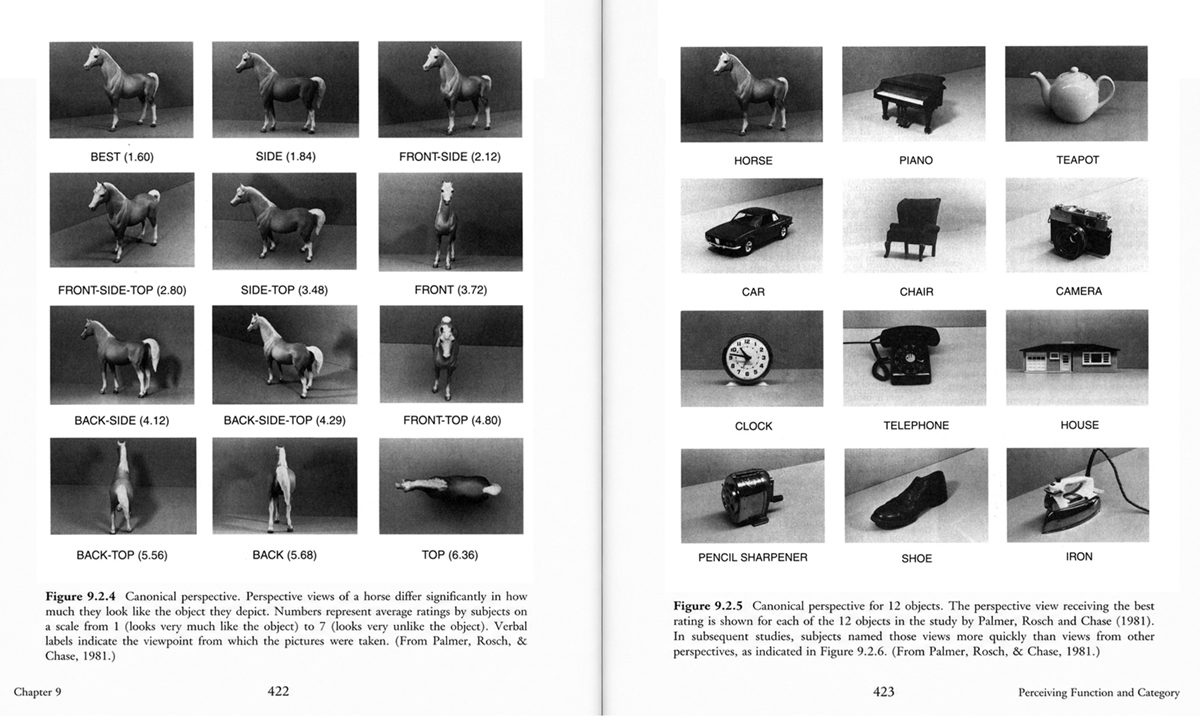
Research on object recognition has long and repeatedly demonstrated that visual perception does not treat all viewpoints or scale relationships equally. In a foundational 1981 study, researchers Palmer, Rosch, and Chase formalized this idea as canonical perspective, describing it as the viewpoints from which objects are most easily and quickly recognized. They put forward the idea that the visual information available from these viewpoints is often associated with the most “representative” or diagnostically useful features of the object. Subsequent discussions of this phenomenon often centered on two related explanatory accounts: the Frequency Hypothesis, which posits that canonical views correspond to the orientations most frequently encountered in the real world, and the Maximal Information Hypothesis, which posits that the canonical perspective reveals the most visually informative and functionally relevant surfaces of the object. While both factors appear to contribute, evidence suggests that canonical perspectives offer the most diagnostic information—the features that best differentiate the object from others, given prior visual experience. Canonical perspective may therefore emerge through the interaction of perceptual learning and ecological exposure, with important implications for visual categorization and object recognition processes.
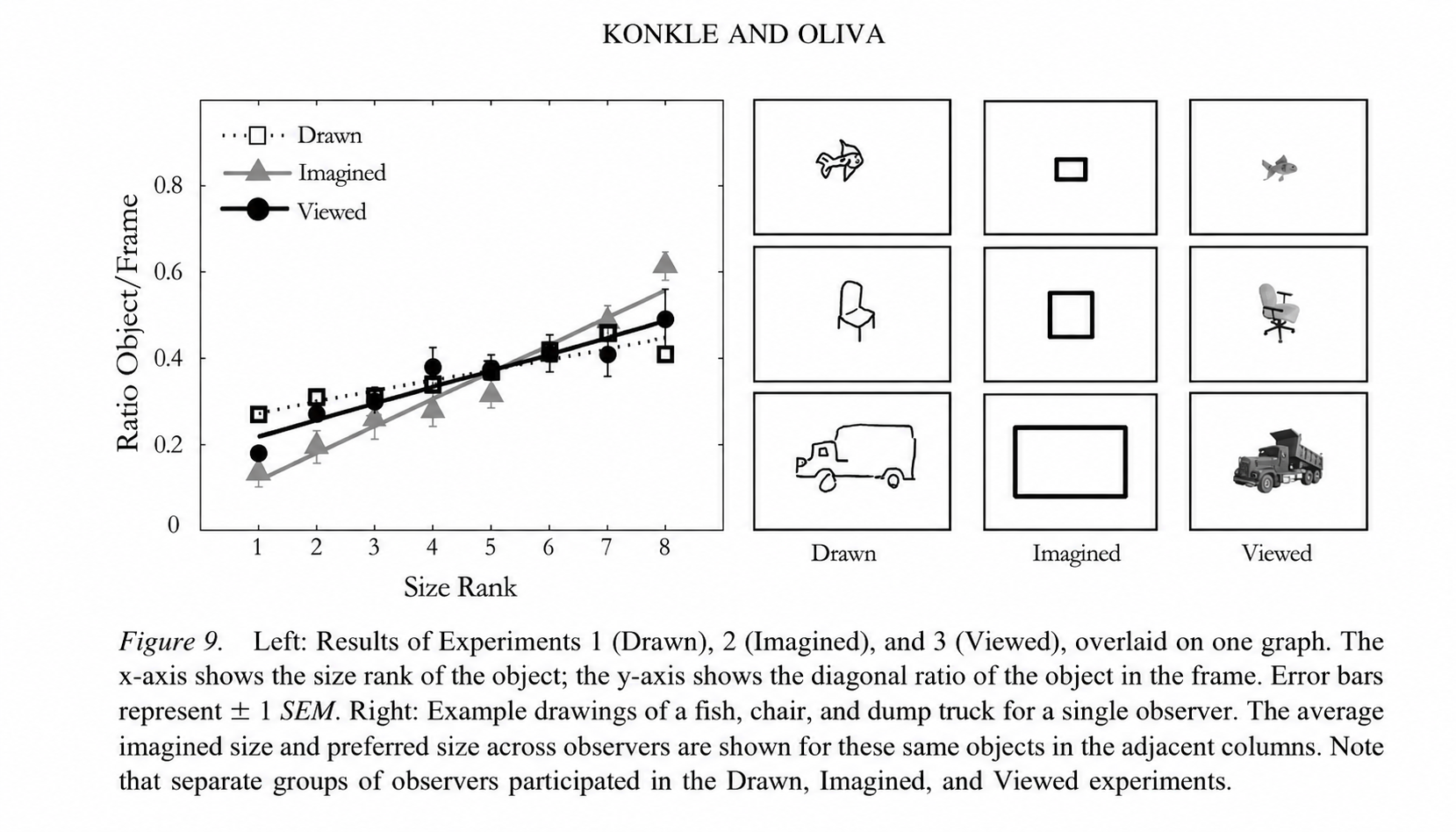
Related work on canonical size has suggested that perceptual systems similarly encode statistically expected scale relationships associated with familiar objects. Studies such as those by Konkle and Oliva (2011) demonstrated that object recognition and perceptual constancy are influenced by internalized expectations regarding the typical size at which objects are ordinarily encountered. Together, these findings imply that perception may be calibrated not simply to objects themselves, but to recurring conditions under which objects are commonly experienced and interpreted.
Knowledge of this phenomenon can be very useful for representational artists in their effort to balance familiarity and novelty. However, I would like to argue that viewpoint or orientation may not be the only aspect or dimension of representation that might reasonably be considered canonical. One such case, as I hope to successfully argue here, may be illumination.
It should go without saying that objects are not encountered under “neutral” illumination. Every visual experience arrives through an interaction between geometry and light, and the history of representational practice suggests that artists recognized this long before the emergence of perceptual psychology or computational vision science. Across centuries of drawing, painting, sculpture, photography, and cinematic portraiture, representational traditions repeatedly converged upon very similar lighting arrangements: elevated, oblique illumination producing asymmetric but moderated shadow patterns across form. Renaissance workshop practice, Baroque chiaroscuro, nineteenth-century atelier instruction, and contemporary portrait lighting systems all demonstrate recurring preferences for what modern studio language often calls “three-quarter lighting.” The persistence of these conventions across media and historical periods raises a question that has received surprisingly little direct theoretical attention: if there are canonical viewpoints for objects, might there also be canonical illumination conditions?
The possibility does not arise from mere matters of style or tradition. Research on shape-from-shading perception has consistently demonstrated that the direction of illumination materially affects the visual recovery of form. Human observers possess strong priors (internal, pre-existing assumptions or expectations about the world) regarding the position of light, particularly the assumption that light originates from above. Alterations to expected illumination geometry can invert convexity judgments, disrupt facial recognition performance, and destabilize surface interpretation. In parallel, studies in computer vision have repeatedly shown that object recognition and surface reconstruction are highly sensitive to illumination structure, with moderate oblique illumination often supporting more robust recovery of surface gradients and volumetric structure than either frontal or excessively lateral illumination. Although these findings emerge from different domains, they converge on a similar principle: visibility itself has organization. Some lighting conditions preserve structurally informative variation more effectively than others.
This paper proposes the concept of canonical illumination as a framework for examining that organization. The argument is not that representational systems converged upon a single mathematically ideal lighting angle, nor that historical artists consciously articulated a unified doctrine of illumination. Rather, the evidence suggests a slower and more distributed convergence. Artistic practice appears to have recurrently converged upon illumination conditions consistent with perceptual and ecological constraints, enhancing volumetric legibility while preserving identity-bearing features. Elevated oblique light often occupies a particularly effective middle range within this problem space. Frontal illumination tends to suppress relief and reduce shape differentiation; extreme lateral illumination can significantly increase contrast but often obscures critical structure. Between these poles lies a family of lighting conditions capable of balancing continuity, depth, asymmetry, and recognition.
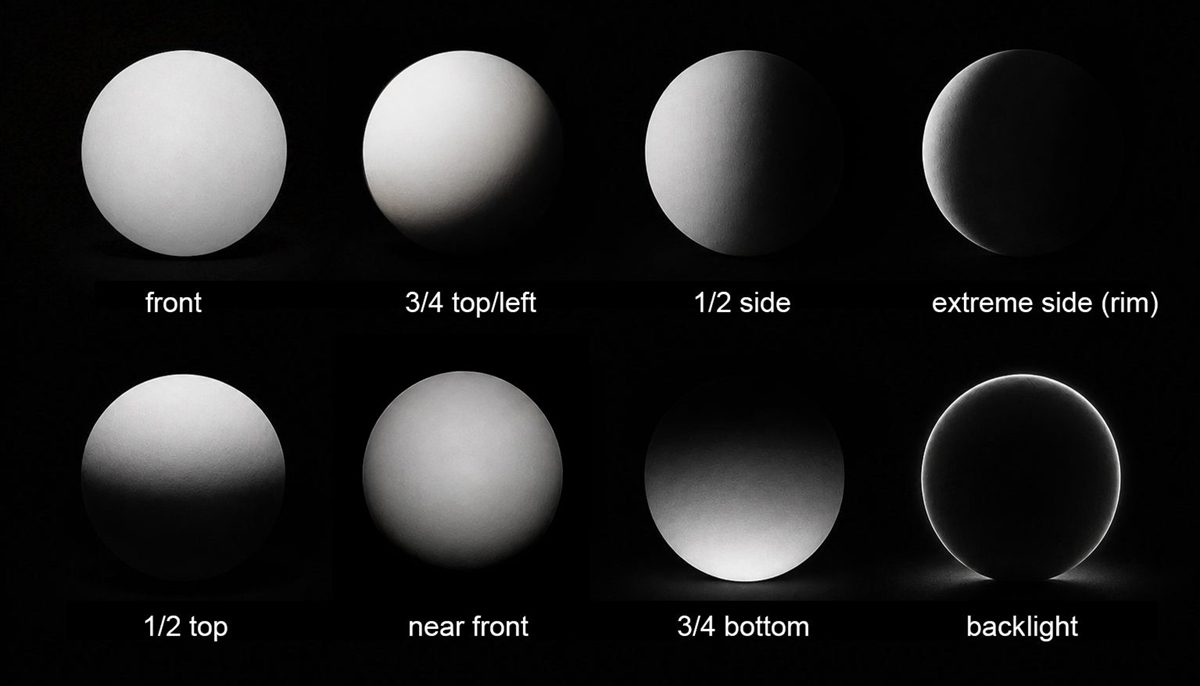
Canonical perspectives appear to emerge when particular viewpoints provide more effective access to structurally informative features than the available alternatives—perhaps maintaining the same or a similar balance between maximal information and frequency of occurrence. This paper proposes that representational traditions and perceptual systems may similarly converge upon illumination conditions that enhance both the perception and visual communication of volumetric structure, surface continuity, and identity-bearing information.
Canonical Perspective and Structural Visibility
The significance of canonical perspective extends beyond simple familiarity or recognition speed. What makes certain viewpoints especially useful appears to be their ability to preserve relational structure while avoiding the informational collapse associated with frontal symmetry or profile concealment. A frontal view may suppress depth relationships through overlap reduction and planar compression, while a strict profile can obscure substantial portions of an object’s organization altogether. Intermediate or oblique orientations often avoid both conditions simultaneously, exposing multiple surfaces, transitions, and spatial relationships at once.
This seeming preference for obliquity (orientation away from frontal or profile extremes) appears throughout studies of object recognition, memory retrieval, and viewpoint-dependent perception. Tarr and Pinker (1989), for example, demonstrated that recognition performance systematically deteriorates as objects rotate away from previously learned orientations, suggesting that object recognition is shaped not only by geometry itself, but by conditions of perceptual access to that geometry. Bülthoff and Edelman (1992) similarly found strong viewpoint dependencies in recognition tasks involving unfamiliar three-dimensional forms, with intermediate oblique views often supporting superior recognition performance. These findings reinforce the broader implication that visibility is not evenly distributed across orientations. Some viewpoints preserve structurally informative variation more effectively than others.
This may help explain why canonical perspectives so frequently occupy intermediate angular positions rather than frontal, profile, or orthographic extremes. Oblique viewpoints often preserve a favorable balance between continuity and differentiation. Multiple surfaces remain visible simultaneously, depth transitions become more explicit, and part relationships can be evaluated continuously rather than inferred from isolated contours or silhouettes. The result is not simply greater complexity, but greater legibility of coherent form.
Again, I think it is no great leap to see that the implications of this pattern likely extend beyond viewpoint alone. If oblique spatial orientations repeatedly enhance structural recoverability, similar asymmetries may also emerge through illumination geometry. Just as frontal viewpoints can suppress depth differentiation, frontal illumination can reduce volumetric legibility by minimizing shading gradients across form. Extreme lateral illumination introduces a different problem: it increases contrast while often obscuring substantial structural information in shadows. Between these poles lies a range of illumination conditions capable of preserving both continuity and differentiation across visible form.
Illumination as a Determinant of Structural Visibility
A substantial body of shape-from-shading research demonstrates that perceived form remains highly sensitive to illumination geometry, even when contour information remains unchanged. Convex forms can appear concave, shallow relief can invert, and otherwise stable surface relationships can become perceptually ambiguous when expected lighting conditions are disrupted. These effects suggest that the visual system does not passively register luminance values but actively interprets them based on assumptions about how light typically behaves in the world.
Importantly, illumination was not entirely absent from research on canonical perspective itself. Studies investigating viewpoint recognition typically relied on relatively stable or controlled lighting conditions to isolate orientation effects. In this sense, illumination often functioned as a constrained background variable rather than a primary object of inquiry. Yet this methodological stabilization also suggests an implicit recognition that structural visibility depends not only on viewpoint but also on illumination conditions capable of preserving coherent form information across visible surfaces.
Some of the most influential work in this area came from V.S. Ramachandran, whose experiments demonstrated how strongly perceived relief depends on the assumed direction of illumination. When illumination assumptions are experimentally inverted, convex forms may suddenly appear concave, and concave forms may suddenly appear convex. Subsequent work by Koenderink, van Doorn, Todd, and others reinforced this broader conclusion, demonstrating that surface interpretation depends not simply on brightness magnitude but on the spatial organization of gradients across form.
Among the most consistently replicated findings in illumination research is the so-called light-from-above prior. Generally, observers tend to interpret ambiguous shading patterns as if they were illuminated by an elevated source, even when no explicit lighting information is provided. Because natural illumination overwhelmingly originates from overhead sources, perceptual systems appear to internalize this regularity as a default interpretive constraint. Importantly, however, this prior is not immutable. Adams, Graf, and Ernst demonstrated that the light-from-above prior can be modified through active experience, suggesting that assumptions about illumination are both ecologically grounded and adaptable. Convexity judgments, depth interpretation, and shape recovery can all shift dramatically when apparent illumination direction violates expected overhead geometry. Familiar examples include crater-mound reversals in topographic imagery, where rotating an image by 180 degrees can invert the perceived relief entirely.
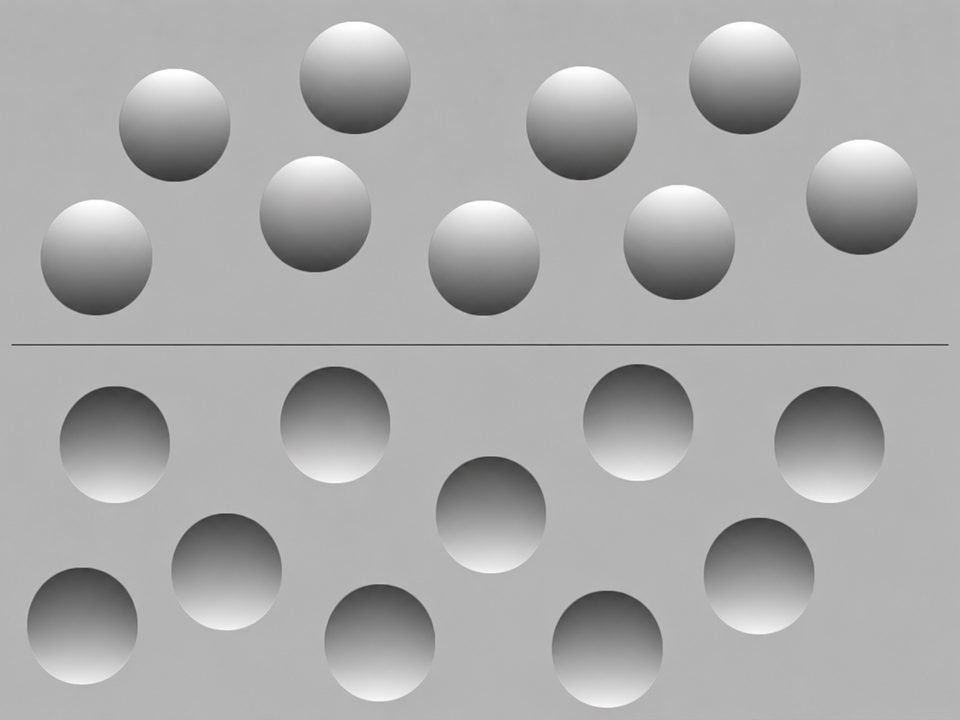
Evidence for a more specific leftward illumination bias has also received considerable attention, though the findings remain more variable and theoretically contested. Several studies suggest that observers behave as though light originates not simply from above but from slightly above and to the left. Explanations for this asymmetry have included hemispheric lateralization, attentional biases, reading direction, and historical studio practices. However, the evidence remains less stable and less universally replicated than the broader light-from-above effect, and caution is warranted when interpreting leftward biases as evidence for a rigid or universal canonical lighting direction.
Taken together, this research suggests that illumination conditions materially influence the interpretation and recovery of visible form. Some lighting arrangements appear to preserve coherent structural variation more effectively than others, particularly when they align with ecologically familiar assumptions regarding light behavior. If canonical viewpoints emerge through recurrent advantages in structural accessibility, illumination conditions may exhibit comparable regularities—not as fixed formulas, but as recurrent solutions to the problem of making form intelligible.
Illumination and the Preservation of Identity
The influence of illumination extends beyond shape interpretation alone. Changes in lighting geometry can also significantly alter recognizability, facial interpretation, and the apparent stability of identity itself. This becomes especially evident in studies of face perception, where even relatively modest shifts in the direction of illumination can reorganize the visibility of critical facial relationships. A face illuminated from below, for example, may retain all of its physical features while nevertheless appearing unfamiliar, distorted, or difficult to interpret. The geometry of the face remains unchanged, yet the organization of visible information does not.
A substantial body of research on facial recognition under variable illumination has demonstrated that identity perception remains highly sensitive to lighting conditions. Hill and Bruce (1996), Johnston et al. (1992), Braje et al. (1998), and others found that changes in illumination direction can significantly influence recognition accuracy and perceived facial similarity, even when the viewpoint remains stable. These findings suggest that facial recognition depends not simply on the presence of features but on the preservation of a sufficiently coherent relational structure across visible surfaces. Illumination changes can reorganize that structure by altering the distribution of contrast, shadow boundaries, gradient transitions, and local surface visibility.
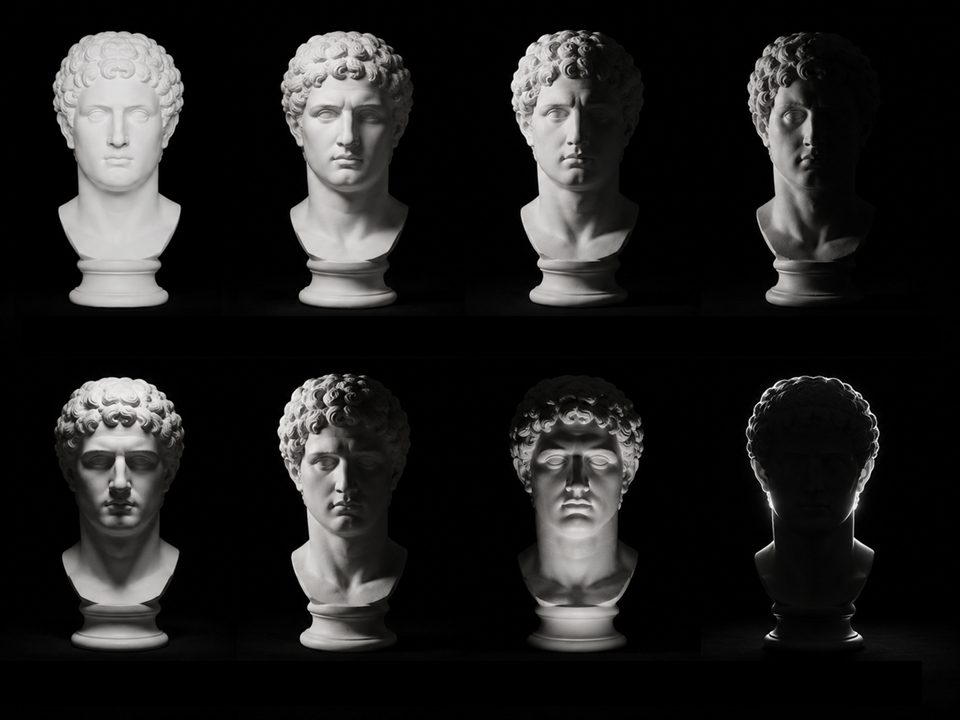
This introduces an important representational tradeoff. As I’ve mentioned earlier, frontal illumination tends to preserve continuity and feature visibility, but often at the expense of volumetric differentiation. Extreme lateral illumination can strongly enhance relief and surface variation, yet may simultaneously obscure substantial portions of identity-bearing structure in shadow. Between these conditions lies a more moderate obliquity capable of balancing both demands simultaneously: enough directional variation to reveal depth and surface organization, enough continuity to preserve stable recognition and relational coherence.
This balancing act may help explain the remarkable persistence of elevated oblique illumination throughout representational practice. Portrait traditions have rarely stabilized around either perfectly frontal or extremely lateral lighting conditions (though both have often been and continue to be used effectively in appropriate contexts). Instead, representational artists repeatedly appear to gravitate toward lighting arrangements that promote both form and identity within a single image. Such illumination arrangements may function as an important compensatory strategy for building novelty from the foundations of familiarity. In other words, while representational artists routinely deploy numerous compensations (exaggerations, omissions, distortions) to communicate the three-dimensional world on a two-dimensional surface, additional organizational cues that support stable recognition may become increasingly attractive.
Importantly, this does not imply the existence of a single ideal illumination formula. Different representational goals may favor very different lighting strategies. Caravaggio’s theatrical contrasts, photographic glamour lighting, forensic facial imaging, and atelier cast drawing all operate under distinct perceptual priorities. Nevertheless, the repeated recurrence of moderate oblique illumination across these domains suggests that certain lighting arrangements may offer recurrent advantages for preserving structurally informative variation without destabilizing recognition. Once again, if canonical perspective emerges partly because some viewpoints preserve especially useful access to object structure, canonical illumination may emerge through related constraints governing the preservation of identity under light. In this sense, elevated oblique illumination may function less as a stylistic convention than as a recurrent perceptual solution to the competing demands of relief, continuity, and recognition.
Historical Convergences in Representational Illumination
Right off the bat, I want to be clear that the historical record does not appear to offer any single origin point for something like canonical illumination. There is no obvious moment when artists collectively declared elevated oblique light to be the correct or ideal condition for representation. Rather, what we do find is a slower accumulation of practices, treatises, studio habits, and pictorial solutions in which directional light becomes increasingly important for conveying relief, depth, and visual coherence.
Early workshop literature already suggests an awareness that light and shadow must be handled coherently if painted form is to appear convincing. Cennino Cennini’s Il Libro dell’Arte belongs to a practical workshop tradition concerned with modeling, gradation, and the disciplined construction of relief. Alberti’s De Pictura moves this concern into a more theoretical register, treating painting as a rational art of visibility, projection, and convincing bodies in space. Neither writer should be read as prescribing a modern three-quarter lighting setup, nor as advancing a doctrine of canonical illumination in the strict sense. Both, however, belong to a developing tradition in which the organization of light, shadow, and tonal transition becomes increasingly important for making form intelligible.
Leonardo da Vinci intensifies this trajectory. The writings associated with his theory of painting, preserved through manuscript notes and later compilations, repeatedly return to light, shadow, reflection, and gradation as structural conditions of appearance. Here, the relevance to the idea of canonical illumination is especially strong, though it still requires that I am appropriately cautious about claiming what Leonardo did or did not put forward. He did not invent or codify anything like “45-degree lighting” in the modern studio sense. What he did do was analyze illumination geometrically and perceptually, treating shadows and light transitions as fundamental to the visibility of form. Such concerns suggest an understanding that form is not simply outlined but revealed through the organized passage of light across surfaces.
The Baroque period offers a somewhat different kind of evidence. In Caravaggio, Rembrandt, and related traditions of chiaroscuro and tenebrism, directional illumination becomes overtly dramatic, selective, and a psychological device. Light is no longer simply used to clarify form; it actively directs attention, organizes narrative, and intensifies emotional impact. Important variations do remain within this period, though, as Rembrandt’s illumination is often dramatic but generally more atmospheric, tonal, and structurally moderated than the sharper, more abrupt lighting commonly associated with Caravaggio and later Caravaggisti. The strong takeaway from this period is that, despite the expanded role of light, we still find a recurring tension between expressive contrast and structural legibility—between illumination that almost “overwhelms” form and illumination that preserves it.
The strongest evidence for a converging form of standardization appears later in studio and academic practice. North-light studios, cast drawing, controlled figure setups, and repeated use of elevated oblique illumination all suggest a pedagogical utility: certain lighting arrangements may facilitate the analysis, communication, comparison, and correction of form. Cast drawing, in particular, often relies on stable illumination conditions because (regardless of the colloquial goal) the learner is not simply reproducing an object, but developing the ability to identify planar relationships, manage value transitions, and navigate edge behavior. In early skill acquisition, consistent control variables are especially valuable, as they allow the learner to isolate and evaluate specific perceptual relationships without the added complexity introduced by shifting environmental conditions. Illumination arrangements that reduce unnecessary processing demands may therefore be particularly advantageous when navigating unfamiliar or cognitively demanding visual problems. In this context, elevated oblique illumination functions less as an expressive device and more as a repeatable condition for perceptual training, comparative assessment, and visual instruction.
So while significant support for the broader claim can be found in the historical record, this evidence still requires careful framing. Representational practice does not demonstrate a single, universal doctrine of canonical illumination. It does, however, show repeated convergence around elevated, oblique, and directional lighting conditions that make form legible, organize value relationships, and preserve sufficient continuity for recognition.
Toward a Theory
The preceding sections suggest that illumination may be understood not merely as an expressive or stylistic variable, but as part of a broader family of perceptual regularities that shape how visual information becomes accessible, interpretable, and recognizable. Canonical perspective demonstrates that some viewpoints support object recognition more effectively than others, while canonical size suggests that perceptual systems similarly encode statistically expected scale relationships that influence recognition and constancy. In both cases, perception appears calibrated not simply to objects themselves, but to the conditions under which objects are ordinarily encountered and most efficiently interpreted.
Canonical illumination may belong to this same broader class of perceptual organization. A useful working definition may therefore be proposed: canonical illumination refers to illumination conditions that enhance perceptual access to diagnostically useful structural information while maintaining ecological plausibility and recognition stability.
Importantly, this does not imply a single ideal lighting arrangement, nor a rigid codification of specific ratios and angles. Rather, like canonical size and canonical perspective, canonical illumination would depend on the nature of the target and its context. It describes recurrent lighting conditions that reliably support the intelligibility of form across perceptual and representational contexts. (It is also worth noting that related phrases such as “canonical illumination” or “canonical lighting” have appeared in computer vision, color constancy, and image-normalization contexts, where they typically refer to a standardized reference light, relighting target, or computational baseline. I am using the term differently here: not to describe a fixed technical reference condition, but to propose a perceptual and representational category analogous to canonical perspective and canonical size.)
Three partially overlapping mechanisms appear to contribute to this convergence.
The first is ecological familiarity. Human perceptual systems develop under remarkably stable environmental conditions. Objects are typically encountered upright, under elevated illumination, and within constrained ranges of apparent size. These regularities shape perceptual expectations (priors) and appear to calibrate interpretation itself. The well-established light-from-above prior demonstrates one such calibration, while canonical size research suggests similar priors regarding scale relationships.
The second mechanism involves structural accessibility. Oblique viewpoints frequently preserve useful relations among visible surfaces while avoiding both frontal flattening and profile concealment. Oblique illumination appears to operate similarly. Moderate directional light often reveals curvature, plane transitions, and depth gradients more effectively than either frontal or excessively lateral illumination. A slight lateral bias, especially from the upper left or upper right, may also allow cast shadows to carry additional information about structure and shape. Unlike more directly overhead illumination, which can compress shadows beneath the object and reduce their descriptive value, an elevated oblique source often projects shadows outward in ways that clarify projection, contour, spatial interval, and orientation. In addition, frontal light can suppress relief through gradient compression, while extreme lateral illumination may disrupt continuity through excessive shadowing. In both cases, intermediate obliquity appears to preserve differentiation without sacrificing coherence.
The third mechanism concerns recognition stability. Recognition depends not merely upon the amount of visible information, but upon the organization of information into a sufficiently coherent structure. Canonical perspective preserves access to diagnostically useful relations among forms. Canonical size stabilizes expectations regarding scale and constancy. Canonical illumination may similarly preserve identity-bearing structure while maintaining enough volumetric differentiation to communicate depth and material form. Too little variation can flatten form; too much can destabilize familiar organization. Moderate asymmetry often appears to occupy a particularly effective middle range.
This recurring role of obliquity may represent one of the broader organizational principles linking many representational systems together. Canonical viewpoints frequently occupy intermediate rather than frontal positions. Three-quarter portrait lighting similarly occupies a middle range between flattening symmetry and destructive contrast. Contrapposto preserves stability while introducing directional variation, and asymmetrical composition often distributes differentiation across the image while maintaining coherence. Across these domains, obliquity repeatedly appears to increase structural differentiation without fully sacrificing intelligibility.
The broader implication is not that representational systems converge upon obliquity through explicit theoretical agreement, nor that all successful representation depends upon moderate asymmetry. Frontality, symmetry, perceptual disruption, and extreme contrast all remain powerful artistic tools. Rather, the historical and perceptual evidence suggests that oblique organization repeatedly emerges because it occupies a productive middle range between redundancy and fragmentation. Canonical illumination may therefore represent one expression of a broader perceptual tendency in which representational systems gravitate toward conditions that maximize useful differentiation while preserving coherent access to form.
In Conclusion
Research on canonical perspective demonstrated that visual perception does not treat all viewpoints equally. Certain orientations repeatedly support faster recognition, stronger categorization, and more stable access to diagnostically useful structure. Canonical size research extended this principle, suggesting that perceptual systems also encode expectations about the scale at which objects are ordinarily encountered. Together, these findings imply that perception is shaped not simply by objects themselves, but by recurring conditions of access to those objects.
The evidence explored throughout this paper suggests that illumination may participate in this same broader organization of perception. Across shape-from-shading research, face-recognition studies, atelier pedagogy, portrait traditions, and computational modeling, illumination repeatedly emerges as a variable that profoundly influences how form is interpreted, differentiated, and recognized. Directional lighting alters curvature perception, surface continuity, edge relationships, and identity stability. Some illumination conditions consistently appear to preserve these relationships more effectively than others.
One pattern, in particular, recurs with striking consistency: moderated obliquity. Canonical viewpoints frequently avoid both frontal flattening and profile concealment. Three-quarter illumination similarly occupies an intermediate range between compressed relief and destructive shadow occlusion. Contrapposto, asymmetrical composition, and countless other representational strategies appear to negotiate similar tensions between variation and stability, differentiation and coherence. Across these domains, oblique organization repeatedly emerges as a productive means of increasing structural visibility without fully sacrificing continuity.
This does not suggest the existence of a universal formula for successful representation, nor does it reduce artistic practice to perceptual optimization. Extreme frontality, radical asymmetry, theatrical contrast, and perceptual disruption remain among the most powerful tools available to artists. Yet the historical persistence of elevated oblique illumination strongly suggests that representational systems repeatedly converge upon certain lighting arrangements because they reliably support the communication of form under the constraints of pictorial representation.
Canonical illumination, therefore, offers a way of thinking about light not simply as atmosphere, mood, or dramatic effect, but as a structural condition of visual intelligibility capable of offering us deeper insight into how form is perceived, organized, and communicated. The concept may ultimately prove useful far less as some strict theory of depiction and far more as a framework for understanding why certain illumination arrangements recur so persistently across perceptual systems, representational traditions, and artistic practice. For me, at least, that is more than enough motivation to continue pursuing the idea.
Resources / Further Reading
Core sources
Palmer, S. E., Rosch, E., & Chase, P. (1981). Canonical perspective and the perception of objects. In J. Long & A. Baddeley (Eds.), Attention and Performance IX, 135–151. Lawrence Erlbaum Associates.
Palmer, S. E. (1999). Vision Science: Photons to Phenomenology. MIT Press.
Konkle, T., & Oliva, A. (2011). Canonical visual size for real-world objects. Journal of Experimental Psychology: Human Perception and Performance, 37(1), 23–37.
Tarr, M. J., & Pinker, S. (1989). Mental rotation and orientation-dependence in shape recognition. Cognitive Psychology, 21(2), 233–282.
Edelman, S., & Bülthoff, H. H. (1992). Orientation dependence in the recognition of familiar and novel views of three-dimensional objects. Vision Research, 32(12), 2385–2400.
Bülthoff, H. H., Edelman, S. Y., & Tarr, M. J. (1995). How are three-dimensional objects represented in the brain? Cerebral Cortex, 5(3), 247–260.
Palmeri, T. J., & Gauthier, I. (2004). Visual object understanding. Nature Reviews Neuroscience, 5, 291–303.
Shape-from-shading and illumination priors
Kleffner, D. A., & Ramachandran, V. S. (1992). On the perception of shape from shading. Perception & Psychophysics, 52, 18–36.
Ramachandran, V. S. (1988). Perceiving shape from shading. Scientific American, 259(2), 76–83.
Adams, W. J., Graf, E. W., & Ernst, M. O. (2004). Experience can change the “light-from-above” prior. Nature Neuroscience, 7, 105
Sun, J., & Perona, P. (1998). Where is the sun? Nature Neuroscience, 1, 183–184.
Mamassian, P., & Goutcher, R. (2001). Prior knowledge on the illumination position. Cognition, 81(1), B1–B9.
Adams, W. J., Graf, E. W., & Ernst, M. O. (2004). Experience can change the “light-from-above” prior. Nature Neuroscience, 7, 1057–1058.
Stone, J. V., Kerrigan, I. S., & Porrill, J. (2009). Where is the light? Bayesian perceptual priors for lighting direction. Proceedings of the Royal Society B: Biological Sciences, 276(1663), 1797–1804.
Todd, J. T. (2004). The visual perception of 3D shape. Trends in Cognitive Sciences, 8(3), 115–121.
Illumination, face recognition, and identity stability
Hill, H., & Bruce, V. (1996). Effects of lighting on the perception of facial surfaces. Journal of Experimental Psychology: Human Perception and Performance, 22(4), 986–1004.
Johnston, A., Hill, H., & Carman, N. (1992). Recognising faces: Effects of lighting direction, inversion, and brightness reversal. Perception, 21(3), 365–375.
Braje, W. L., Kersten, D., Tarr, M. J., & Troje, N. F. (1998). Illumination effects in face recognition. Psychobiology, 26, 371–380.
Bruce, V., & Young, A. (1986). Understanding face recognition. British Journal of Psychology, 77(3), 305–327.
Cast shadows, spatial structure, and depth information
Kersten, D., Knill, D. C., Mamassian, P., & Bülthoff, I. (1996). Illusory motion from shadows. Nature, 379, 31.
Mamassian, P., Knill, D. C., & Kersten, D. (1998). The perception of cast shadows. Trends in Cognitive Sciences, 2(8), 288–295.
Casati, R. (2004). Shadows: Unlocking Their Secrets, from Plato to Our Time. Knopf.
Historical and studio-practice context
Cennini, C. (c. 1400/1933). The Craftsman’s Handbook: Il Libro dell’Arte, trans. D. V. Thompson. Yale University Press.
Alberti, L. B. (1435/2011). On Painting, trans. R. Sinisgalli. Cambridge University Press.
Leonardo da Vinci. (c. 1490–1519/2001). Leonardo on Painting, ed. M. Kemp. Yale University Press.
Baxandall, M. (1972). Painting and Experience in Fifteenth-Century Italy. Oxford University Press.
Broader art/perception further reading
Gombrich, E. H. (1960). Art and Illusion: A Study in the Psychology of Pictorial Representation. Phaidon.
Arnheim, R. (1974). Art and Visual Perception: A Psychology of the Creative Eye. University of California Press.
Livingstone, M. (2002). Vision and Art: The Biology of Seeing. Harry N. Abrams.
Shimamura, A. P. (2013). Experiencing Art: In the Brain of the Beholder. Oxford University Press.