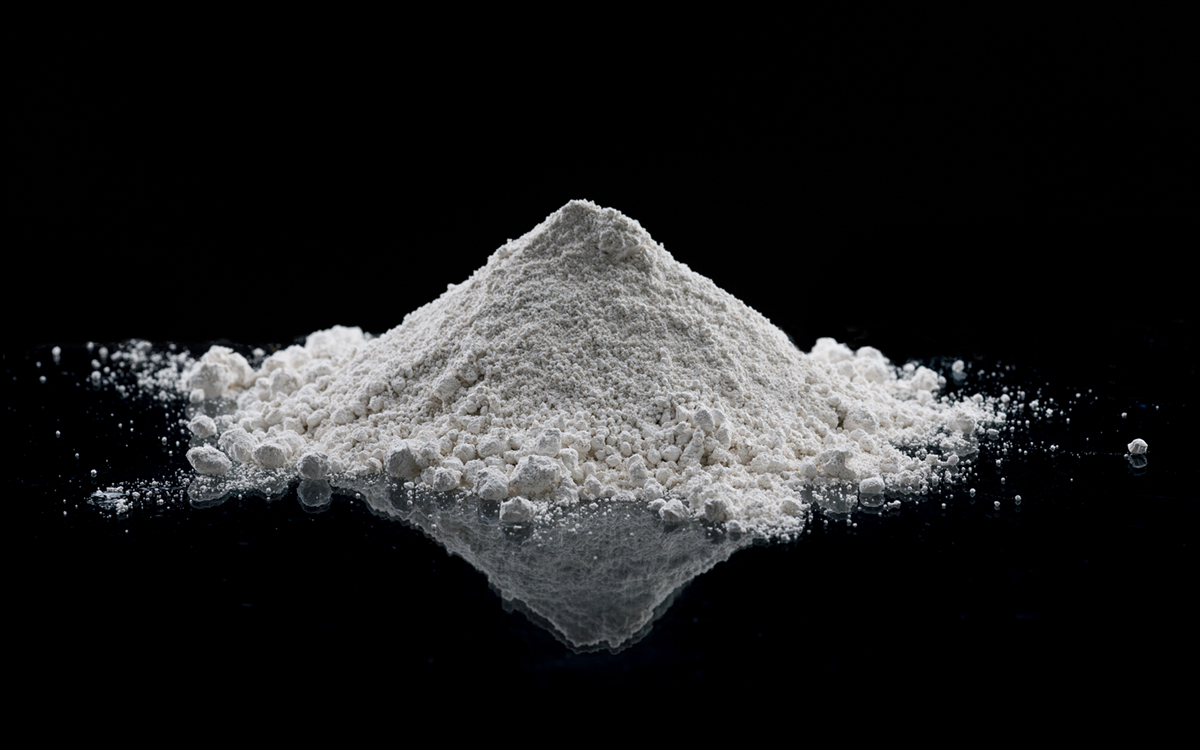
In June 2022, I wrote a short article examining some of the claims surrounding zinc oxide in oil paint systems. The article grew out of several online “debates” about whether zinc oxide belonged in so many popular paint formulations, and whether artists were taking the associated risks seriously enough. After that, the issue largely receded from view for me until a recent discussion in one of our artist roundtables renewed my interest in the subject and raised a simple question: has the evidence changed, and what can we responsibly say now?
Looking back, though, those debates seem less like the beginning of the issue and more like a later public flare-up. The more notable public shift had already happened years earlier. On February 21, 2018, GOLDEN published Sarah Sands’s Just Paint article “Zinc Oxide – Reviewing the Research,” which laid out the conservation research behind its concerns about zinc oxide and explicitly connected that research to GOLDEN’s decision to remove nearly all zinc oxide from the Williamsburg Handmade Oil Colors line. Around the same period, Michael Harding also announced that it would phase out Zinc White and remove zinc from some mixed colors, saying it preferred to err on the side of caution.
Gamblin took a different approach. Rather than announcing a broad removal, it stated that, following discussions with Smithsonian researchers around 2000, it had adopted a guideline of keeping zinc oxide in mixed colors below 15%, while continuing to sell Zinc White and Titanium Zinc White with cautions.
So, as far as I can tell, 2018 was the more significant moment for visible changes in manufacturing, even though the debates I remember flared up much later. My 2022 article was not about the relevant chemistry or physics, but rather about some of the claims and warnings that were being tossed around. Some warnings in the debates were categorical: zinc should not be used in oil painting at all. Some defenses were equally categorical: many zinc-containing paintings have survived, so the warnings must be exaggerated or in error. More moderate positions occasionally chimed in on the engagement landscape, holding that zinc was not invariably disastrous but that its risks depended on formulation, quantity, layer structure, support, and environment.
When researching for this article, there does not appear to have been a single public incident in 2018 that prompted these changes. It, of course, remains possible that a particular conference presentation, private consultation, or unpublished technical exchange helped synchronize manufacturers’ decisions; however, publicly available literature does not seem to point to a single blockbuster 2017–2018 paper. Rather, the announcements appear to mark the point at which a body of conservation research, developing since at least the early 2000s, crossed into public manufacturing policy. Mechanical studies by Marion Mecklenburg and colleagues at the Smithsonian had identified zinc-containing oil paints as unusually brittle, while examinations of twentieth-century paintings—including works in the Hirshhorn Museum and Sculpture Garden—linked zinc-rich underlayers to cracking and interlayer separation. Subsequent research, notably Gillian Osmond’s work on zinc-oxide-centered deterioration, furthered the chemical picture by examining zinc-carboxylate formation, fatty acid migration, and aggregation, and their relationship to structural damage.

Today, several years later, the broad scientific picture has not reversed. Zinc oxide remains a well-documented source of concern in oil paint. However, what has changed is the precision with which researchers can describe its behavior. The evidence now supports a position more exact than either “zinc destroys paintings” or “zinc is harmless.” As such, I believe this is a good formulation of what is the case:
Zinc oxide is a genuine, formulation- and context-dependent conservation risk in oil painting. It can participate in chemical reactions and mechanical changes associated with embrittlement, cracking, interfacial weakness, and delamination. These outcomes are not inevitable in every zinc-containing painting, and no universally safe or unsafe concentration has been established.
The practical question is therefore not simply whether zinc is good or bad. It is:
What benefits does zinc provide, what vulnerabilities can it introduce, and under what conditions are those vulnerabilities most consequential?
Why Zinc White Exists
A balanced discussion about zinc oxide in oil paint must begin by acknowledging its real artistic advantages. Since its introduction in the 1780s by French chemist Guyton de Morveau as a safer white alternative to lead white, it has remained a useful art material for artists worldwide. It was not adopted out of ignorance, and it has not survived in artists’ materials solely by inertia. It also should not be treated as a problem limited only to paints labeled Zinc White. Zinc oxide has appeared not only as a white pigment in its own right, but also in titanium-zinc whites, mixing whites, and some colored paint formulations. That matters because the artistic reasons for using it are often tied to the same basic properties: zinc oxide behaves differently from both lead white and titanium white.
As a white pigment, titanium white is extremely strong: even a small amount can quickly lighten a mixture, reduce its chromatic intensity, and increase opacity. That strength is useful, but it can also make subtle control of value more challenging. Zinc white, by comparison, has much lower tinting strength and usually lower hiding power in oil. Artists have valued it because its weaker, less opaque character can make gradual lightening, smaller value adjustments, cooler or more restrained color modifications, and less abrupt opacity easier to achieve than with a strong scatterer like titanium white. A weak white is not necessarily a defective white; in some passages, that less aggressive effect is precisely the desired property. It is more accurate, though, to say that zinc white can make subtle lightening more controllable than to claim that it simply “preserves chroma.” It is important to note that Zinc white still dilutes color and changes the optical behavior of a mixture.
Zinc white is also generally more translucent in oil than titanium white, which helps explain its appeal in veils, scumbles, certain atmospheric passages, subtle transitions, lightly scattering upper layers, and highlights that are meant to appear luminous without becoming densely opaque. Artists also often describe zinc white as cooler or cleaner-looking than traditional lead white, but that should be understood as a comparative visual effect of the complete paint film, not as an invariant hue belonging to every sample of zinc oxide. The perceived temperature of a white paint can be influenced by the color and yellowing of the oil, pigment concentration, film thickness, surrounding colors, the ground or substrate beneath it, particle morphology, additives, and aging. The same caution applies to handling. Depending on formulation, zinc white may feel smooth, flowing, and less ropey than lead white, or less stiff and overpowering than titanium white. Those qualities can make it attractive for many process functions. But these are properties of a commercial paint system, not of ZnO alone. Oil type, extenders, waxes, metal stearates, dispersants, and other additives can all affect rheology (the way a paint flows, spreads, and holds its shape under the brush), drying, and aging.
All of this also helps explain why zinc oxide has so often been combined with titanium white. The two pigments can moderate one another’s extremes: titanium dioxide contributes opacity and covering power, while zinc oxide can soften that dominance, lowering tinting strength, increasing translucency, smoothing the mixing behavior, reducing abrupt chalkiness, and making gradual value control more attainable. For that reason, paints sold under names such as Mixing White, Soft White, Transparent White, or Titanium White have sometimes contained both titanium dioxide and zinc oxide, depending on the manufacturer and period.
| Zinc-related property | Why artists may value it | Conservation and operational qualification |
|---|---|---|
| Low tinting strength | Can make gradual lightening and controlled mixing more attainable, especially compared with a strong white such as titanium white. | Lower tinting strength does not reduce zinc oxide’s chemical reactivity in oil. |
| Relative translucency | Can be advantageous for certain tasks such as veils, scumbles, certain atmospheric effects, subtle transitions, and less-dense, less-opaque highlights. | Procedural or optical advantage does not imply structural safety in an oil paint film. |
| Relatively cool or clean appearance | May be more advantageous in cooler mixtures, lighting effects, or passages where a less warm influence from a white is desired. | Perceived temperature depends on the complete paint film, including oil color and yellowing, film thickness, surrounding colors, substrate, additives, and aging. |
| Smooth handling | May provide smoother or more fluid handling than some other whites, depending on formulation. | Handling is a property of the full formulation, not ZnO alone. Oil type, extenders, waxes, stearates, dispersants, and other additives may also influence aging. |
| Moderation of titanium white | Can attenuate the power of titanium white by lowering tinting strength, increasing translucency, and softening abrupt opacity or chalkiness. | Mixed whites may contain zinc oxide in proportions that vary by manufacturer and period, and those proportions are not always clearly disclosed. |
| Non-lead white pigment | Avoids the toxicity hazards associated with lead white. | Lower toxicity to the artist does not guarantee better long-term mechanical or chemical stability in an oil paint film. Conversely, lead white has historically been associated with favorable drying and film-forming behavior in oil systems, despite its toxicity. |
| Initially firm or hard film | May feel firm, lean, or set after drying, depending on formulation. | Hardness can coexist with brittleness, reduced flexibility, and low strain tolerance. A hard film is not necessarily a durable one. |
| Useful coating properties outside fine art | Zinc oxide can serve useful roles in some industrial or commercial coating formulations. | Industrial performance targets are not the same as century-scale conservation goals for paintings, especially on flexible supports or in layered paint structures. |
Finally, as mentioned above, zinc white also needs to be understood historically as an alternative to lead white. Lead white has distinctive handling, drying, and film-forming properties, but it poses serious toxicity risks, especially through ingestion, inhalation of dust, contact with contaminated studio surfaces, waste, and chronic exposure. Zinc white’s adoption therefore reflected a legitimate search for a less toxic white pigment for artists and industry. Titanium dioxide later provided a much more opaque non-lead white, but it did not reproduce zinc white’s particular combination of translucency and low tinting strength. That is why zinc retained a distinct artistic role, even as later conservation research made its risks in oil paint much harder to ignore.
What Happens in a Zinc-Containing Oil Paint Film
As many reading this already know, oil paint does not dry in the same way that water evaporates from a puddle. In a traditional drying oil, such as linseed, walnut, or poppy oil, the binder cures mainly through reactions with oxygen from the air. This process, called autoxidation, gradually links oil molecules together into a solid polymer-like network. In simple terms, the wet oil becomes a flexible but increasingly firm web of connected molecules.
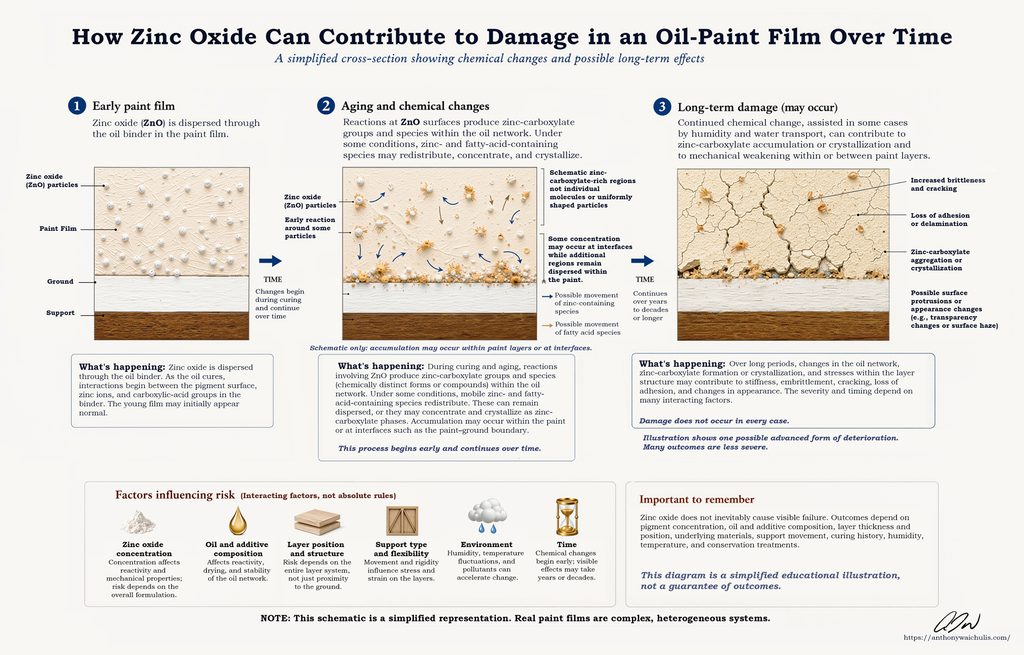
That web, however, does not become chemically frozen forever. Even after the paint feels dry, the film continues to change with age. Oxygen can keep reacting with the binder; chemical bonds can break and reform; water can participate in slow hydrolysis (chemical breakdown involving water) reactions; and small molecular fragments can be produced inside the paint. Some of these fragments include fatty-acid-related compounds, which are especially important in zinc-containing paints.
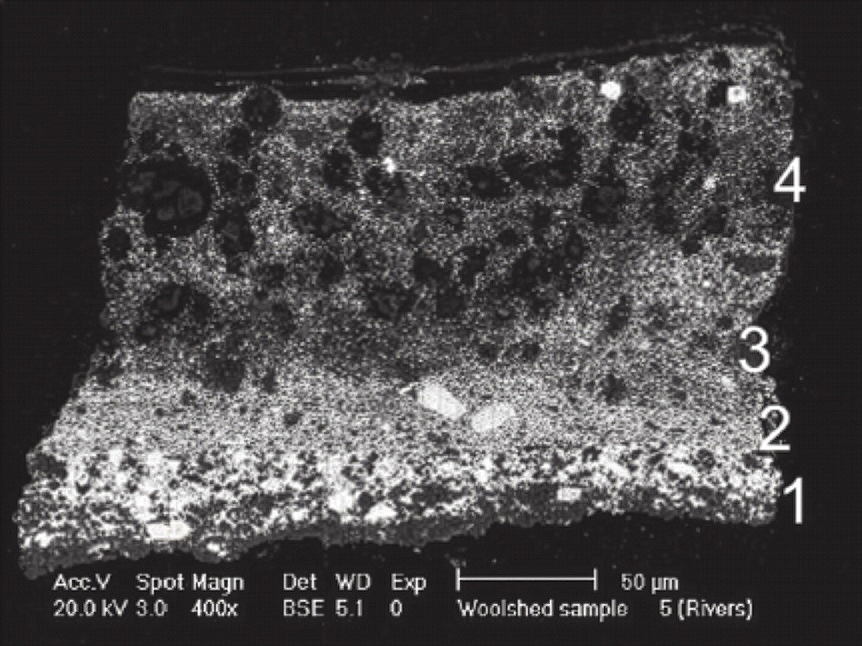
Zinc oxide (ZnO) is not merely an inert white powder suspended in this system. In an oil paint film, ZnO particles can interact chemically with the aging oil binder. Reactions at or near the surfaces of zinc oxide particles can produce zinc carboxylates, often called zinc soaps. These are zinc-containing compounds formed when zinc becomes associated with carboxylate groups. They’re called soaps because, chemically, they are close relatives of ordinary soap. Traditional soap is made by reacting fatty acids from fats or oils with an alkali metal such as sodium or potassium. In an oil painting, fatty acids in the drying oil can react with metal ions in pigments. When the metal is zinc, the product is a zinc carboxylate:
A carboxylate group can be thought of as the reactive “hook” end of a fatty acid or fatty acid fragment. Zinc can act like a metal connector that binds to these hook-like groups. When enough of these zinc-carboxylate structures form, they may remain dispersed throughout the paint, alter the binder network, or, under certain conditions, gather and crystallize in specific regions.
Zinc Carboxylates Are Not All the Same
It is important not to treat all zinc carboxylates as if they were one single substance with one single effect. In an aged oil paint film, zinc-containing material may exist in several different states. Some zinc may be coordinated to carboxylate groups within the polymerized oil binder itself, forming an ionomer-like network (a polymer structure partly linked by metal ions). This means the zinc is not necessarily present as loose, free-floating ions. Rather, it can be bound into the structure of the aged oil film, helping to create a network that is chemically distinct from that of an ordinary oil binder.
Other zinc-containing compounds may be more mobile. Zinc carboxylates can redistribute, concentrate, aggregate, or crystallize. These more concentrated forms are often what people imagine when they hear the phrase “zinc soaps,” but they are only part of the story. Depending on their form and location, zinc carboxylates may remain incorporated within the binder, alter the paint’s stiffness or brittleness, be redistributed through parts of the film, accumulate near pigment particles or layer boundaries, crystallize, affect transparency or surface appearance, or weaken adhesion between paint layers.
This distinction matters because simply detecting a zinc carboxylate does not automatically mean that a painting is failing. It does, however, show that the zinc oxide and oil binder are chemically interacting. In some paintings this chemistry may remain relatively harmless; in others, especially when combined with unfavorable formulation, layer structure, moisture exposure, or mechanical stress, it may contribute to visible damage.
Mobility and Redistribution Inside the Paint
Oil paint may look like a solid, stable material, but at the microscopic and molecular levels, it is not completely still. Small molecules, fatty acid fragments, metal-containing compounds, and other low-molecular-weight materials can migrate within an aging paint film. In layered paintings, some materials may also migrate between layers.
In zinc-containing systems, this means zinc-related reaction products do not always remain exactly where the original zinc oxide particles were. Some zinc-containing and fatty acid-derived compounds may be redistributed within the paint. Others may concentrate near pigment particles, at the boundary between paint and ground, or between different paint layers. This is why the amount of zinc oxide in a tube of paint is not the only relevant factor. A paint containing zinc oxide may behave differently depending on the oil used, the pigment concentration, the presence of additives, the layer thickness, the type of ground beneath it, and the environmental conditions the painting experiences over time.
In practical terms, the question is not simply:
Does this paint contain zinc oxide?
The more useful question is:
Where is the zinc oxide, what is it reacting with, and where do the reaction products end up?
The Role of Water
Water can also affect what happens inside an aging oil-paint film. Even small amounts of moisture may contribute to hydrolysis, a reaction in which water helps break chemical bonds in the oil binder, releasing smaller compounds, including free fatty acids. Moisture can also make some of these compounds more mobile, allowing them to move through the paint film. In zinc-containing paints, this movement may help zinc ions and fatty acids come together, contributing to the formation, migration, or crystallization of zinc carboxylates.
This does not mean that every painting containing zinc oxide will absorb large amounts of water or develop zinc-related damage. Laboratory studies often use controlled or extreme conditions to understand what a material is capable of doing. Such experiments are valuable because they reveal possible mechanisms, but they should not be treated as proof that every painting in ordinary storage will behave the same way. A fair way to state the issue is this: water can be an important contributing factor, especially under humid or fluctuating conditions, but it is not the sole cause of zinc-related deterioration.
Mechanical Consequences
The chemical changes in zinc-containing oil paint matter because they can affect the mechanical behavior of the paint film. Several terms are often used loosely, but they describe different properties.
| Property | More precise plain definition | What it helps explain |
|---|---|---|
| Hardness | Resistance to localized surface deformation, such as scratching, indentation, or abrasion | Scratching, denting, polishing, and surface wear. Low hardness or tackiness may also contribute to dirt pickup, although dirt pickup is not determined by hardness alone. |
| Stiffness | Resistance to elastic deformation under an applied force. | How much stress develops when a paint layer is forced to stretch or bend relative to its support. A stiff film may develop greater stress for a given amount of movement, but stiffness alone does not determine whether it cracks. |
| Strength | The maximum stress a material can withstand before yielding or failing | Whether a film can withstand tensile or other stresses before rupture. “Tearing” is less suitable as a general example because paint films commonly fail by cracking or tensile rupture rather than by tearing, as with fabric. |
| Toughness | The amount of energy a material can absorb before it fractures; represented by the area under its stress–strain up to failure. | Whether a film can endure a combination of stress and deformation before breaking. It can relate to impact resistance, but also to slower stretching or bending. |
| Brittleness | A tendency to fracture after very little deformation, usually reflected in low strain at break | Sudden cracking or fragmentation with little prior stretching or yielding. Flaking and cleavage may follow, but they also depend on adhesion between layers. |
| Strain at break/strain to failure | The amount of relative stretching or deformation a material can undergo before it breaks | Whether a paint film can accommodate movement of the canvas, panel, ground, or adjacent layers without cracking. |
A material can be hard but brittle, stiff but not tough, or strong but unable to tolerate much movement. For paintings, this distinction matters because a paint film needs to resist pressure and scratching; it also needs to withstand bending, canvas movement, vibration, and environmental changes. A simple analogy is the difference between a dry cracker and a strip of leather. A cracker feels hard when pressed with your finger, but it snaps easily when bent. Leather feels softer, but it can bend, stretch, and absorb movement without breaking. For paintings, long-term durability depends less on hardness alone and more on the paint film’s ability to tolerate movement.
This is especially important for paintings on stretched canvas. Canvas responds to handling, vibration, impact, changes in tension, and shifts in humidity and temperature more than a rigid substrate does. A flexible paint layer may survive these movements; however, a brittle or poorly adhered layer may crack, lift, or separate from the layer beneath it. Zinc-containing oil paint films have repeatedly been associated with increased stiffness, reduced strain tolerance, and brittleness. This does not mean that every zinc-containing painting will fail. It means that zinc oxide can contribute to a paint structure that is less able to accommodate movement, especially when other risk factors are present.
The Importance of Layer Position
The location of zinc oxide within a painting may be as influential as its amount. Zinc in a small surface passage does not carry the same structural significance as zinc in a ground preparation layer or a broad lower paint layer. This distinction matters because paintings are layered systems. A weakness in one small area may remain local, while a weakness in a continuous lower layer can affect the mechanical integrity of the entire paint structure.
Zinc in Grounds and Broad Lower Layers
Zinc oxide is especially consequential when it is present in a ground or broad lower layer. These layers often cover most or all of the support, lie beneath later paint layers, contribute to adhesion, and help distribute mechanical strain throughout the painting. If such a layer becomes brittle, weakly bonded, or chemically altered, it can serve as a fracture plane for the entire paint system. Such concern is therefore both chemical and structural. Chemically, a large zinc-containing layer contains more material that can react with the oil binder, forming zinc carboxylates. Structurally, its position means that deterioration is not isolated to a small paint passage. If the ground or lower layer loses cohesion or adhesion, everything above it may be affected.
For this reason, the strongest practical recommendation is:
Avoid zinc oxide in oil grounds and broad, mechanically important lower layers when long-term stability is a priority.
It’s important to note that this recommendation is precautionary. It does not mean that every zinc-containing ground will fail, nor does it prove that every lower zinc-containing layer reacts faster than every upper layer. Rather, it reflects the greater consequence of failure in a layer that supports the rest of the painting.
Thin, Localized Upper Passages
A small amount of zinc oxide in a thin, localized upper passage presents a different risk profile. Such use may involve less total reactive material, a smaller affected area, and less structural responsibility for the paint layers above it. If damage develops in a small upper passage, it may remain localized rather than undermining the entire multilayer system.
However, it would be quite misleading to say that upper layers are free from mechanical strain. In a bonded paint structure, all layers respond to the support’s movement. Outer layers may experience significant tensile or compressive strain when a canvas bends, flexes, or changes tension. The more defensible distinction is therefore not that upper layers are mechanically safe, but that their failure may be less system-wide in scope. In other words, the issue is one of consequence, not immunity. A thin zinc-containing surface passage may still crack, haze, become brittle, or develop zinc-carboxylate-related changes. But because it is localized, it is generally less likely to compromise the whole painting than a zinc-rich ground or broad lower layer. I think it is reasonable, then, to say that localized “upper” use should be understood as potentially less consequential in context rather than automatically safe.
Thick Zinc-Rich Impasto
Thick zinc-rich impasto presents another kind of risk. In a thick paint passage, drying and aging may not occur evenly throughout the layer. The surface and interior can experience different rates of oxidation, crosslinking, and mechanical change. This can create internal stress, drying gradients, and differences in stiffness within the same paint mass.
Possible concerns in thick zinc-rich passages include:
- uneven drying or curing;
- internal stress;
- differential oxidation between surface and interior;
- increased stiffness;
- local cracking;
- fracture within the impasto;
- weak attachment to more flexible underlying layers.
It is important to note here that thickness should not be treated as a simple universal rule. A thick passage is not automatically worse in every case, and a thin passage is not automatically safe. Geometry, formulation, support type, pigment concentration, oil composition, environmental history, and adhesion to surrounding layers all matter. The key point is that thick impasto can create local mechanical problems, while zinc in a ground or broad lower layer can create system-wide problems. These are different risk profiles.
Beyond “The Dose Makes the Poison”
One of the phrases I often use when discussing zinc oxide to collapse some factors is “the dose makes the poison”. And while I find this is a potentially useful association in that it reminds us that a trace amount of zinc is not the same as a zinc-rich layer, it can help gloss over the overly simplistic idea that any amount of zinc oxide must produce identical damage, and I’d like to address it. As you should realize by now, dose alone is too simple a metric for a layered painting. For example, as we’ve discussed, a relatively small proportion of zinc oxide distributed throughout a broad ground or lower preparation layer may be more consequential than a higher concentration confined to one small upper highlight.
It is also important to define what is meant by a stated percentage of zinc oxide. A percentage may refer to pigment mass (the weight of the dry pigment only), total wet-paint mass (the weight of everything in the tube, including oil and additives), dry-film mass (the weight after the paint has cured and lost volatile components), pigment volume (how much physical space the pigment particles occupy in the paint), elemental zinc (the amount of zinc element present, not the amount of zinc oxide compound), or the proportion of one tube paint added to another (for example, mixing 10% Zinc White into Titanium White on the palette). These quantities are not interchangeable. A paint described as “10% zinc” could mean very different things depending on how the percentage was calculated.
On paint tubes, there is usually no single standardized, consistently disclosed “percentage of zinc oxide” method for artists’ oil colors. Tubes commonly list pigment names or pigment index codes, such as PW4 for zinc white/zinc oxide, but they often do not state the actual percentage. When manufacturers do mention zinc percentages publicly, the basis is not always obvious unless they define it. For example, Gamblin says it keeps zinc oxide in mixtures with other pigments below 15%, but that statement should not be treated as a universal labeling standard for all brands or all tube labels.
For this reason, there is no “universal safe percentage” that applies to every painting. Zinc-related risk depends not only on the amount of zinc oxide present but also on other factors, including those mentioned above.
With that said, here are some of the numbers I could find online for several paint lines:
| Brand/line | Color | Zinc oxide % found | Notes |
| Winsor & Newton Winton Oil | Titanium White | 5–10% | The current W&N product page lists PW4/PW6; the W&N SDS lists zinc oxide at 5–10%. |
| Winsor & Newton Artists’ Oil | Titanium White | 5–10% | The current W&N product page lists PW4/PW6; a Blick/W&N SDS from 2015 lists zinc oxide at 5–10%. |
| Royal Talens Rembrandt Oil | Titanium White 105 | 5–10% | Current Royal Talens SDS, dated/revised 2026, lists zinc oxide at 5–10%. |
| Royal Talens Van Gogh Oil | Titanium White 105 | 5–10% | Current Royal Talens SDS, revised 2025/printed 2026, lists zinc oxide at 5–10%; product page also lists PW6/PW4. |
| Old Holland Classic Oil | Titanium White, older SDS | 10–25%, not 10–20% | Older Old Holland SDS lists zinc oxide at 10–25%. |
| Old Holland Classic Oil | Titanium White, current 2025 SDS | No zinc oxide listed | The current Old Holland Titanium White SDS lists titanium dioxide at 70–90% but does not list zinc oxide in Section 3. |
| Old Holland Classic Oil | Mixed White Zinc/Titanium, current 2025 SDS | 30–50% | The current Old Holland Mixed White Zinc/Titanium SDS lists zinc oxide at 30–50% w/w and titanium dioxide at 30–50% w/w. |
| Michael Harding | Titanium White No. 1 | 0% detected from current listing; PW6 only | Current Michael Harding listing gives Color Index PW6 only. |
| Michael Harding | Titanium White No. 2 | 0% detected from current listing; PW6 only | Current Michael Harding listing gives Color Index PW6 only. This is important because some older/retailer text appears to conflict with the current official listing. |
Zinc Damage Is Conditional, Not Inevitable
Zinc oxide is best understood not only as a pigment ingredient, but as a material whose risk depends on many factors. A zinc-rich ground may affect the entire paint structure while a thin upper passage may pose a more localized risk. A thick impasto passage may create internal stress and local cracking. None of these situations guarantees failure, but they do not carry equal consequences. In practical terms:
The amount of zinc matters, but so does its position, thickness, continuity, and structural role within the painting.
This is why warnings about zinc oxide are strongest for oil grounds, broad lower layers, and structurally important paint passages. The concern is not simply that zinc oxide can react, but that reactions in the wrong place may weaken the physical foundation of the painting itself.
The most important point here is that zinc oxide should be understood as a risk factor, not a guaranteed cause of failure. A zinc-containing paint film may remain stable for many years if the formulation, layer structure, environment, and support are favorable. Problems are more likely when several risk factors combine. Those risk factors may include a high zinc oxide concentration, a brittle oil network, unfavorable additives, a zinc-rich layer placed over or under incompatible layers, a flexible canvas support, poor adhesion between layers, high humidity, temperature fluctuation, or later conservation treatments that alter the paint’s chemistry or mechanics.
In plain terms: zinc oxide does not automatically ruin an oil painting. But in some paint systems, over long periods, it can help make the paint film less flexible, less well-adhered, and more vulnerable to damage. It’s important to remember that an oil painting is a layered chemical and mechanical system. Its condition, in this context, depends on interactions among many variables, including:
- zinc concentration;
- pigment volume concentration;
- method of ZnO manufacture;
- particle morphology;
- pigment coatings and impurities;
- oil type;
- fatty-acid availability;
- additives and extenders;
- film thickness;
- drying history;
- adjacent pigments and layers;
- age before overpainting;
- ground absorbency;
- support type;
- support preparation;
- relative humidity;
- temperature;
- handling;
- vibration;
- framing;
- previous conservation treatment.
This is why two paintings containing zinc may age very differently.
Not All Zinc White Is the Same
It is also important to recognize that “zinc white” is not one perfectly uniform material. The label usually indicates that the pigment contains zinc oxide, but it does not tell us everything about how that pigment will behave within an oil paint film. Historical and modern zinc oxide pigments can differ in many ways, including how they were manufactured, the size and shape of the particles, the chemistry of their surfaces, the presence of coatings or impurities, how strongly the particles clump together, and how they interact with the oil binder. These differences may affect not only the color and handling of the paint, but also its long-term chemical and mechanical behavior.
A pigment labeled PW4 identifies zinc oxide as the pigment. However, that code alone does not reveal enough to predict whether a particular paint film will remain stable, become brittle, form zinc carboxylates, or develop adhesion problems. PW4 tells us which pigment family is present, not the full recipe or the paint’s long-term behavior.
The surrounding formulation also matters. A tube of zinc-containing oil paint may include aluminum or magnesium stearates (fatty acid salts used as additives), waxes, extenders, driers, stabilizers, various drying oils, or proprietary dispersing agents. These ingredients can influence how the paint handles, how it dries, how much fatty-acid material becomes available, how water moves through the film, and whether zinc-containing compounds remain dispersed or begin to aggregate and crystallize.
As I hope is now abundantly clear, zinc oxide does not act alone. It is part of a larger material system. The same nominal pigment may behave differently depending on particle properties, oil type, additives, pigment concentration, layer thickness, and environmental history. This is why simple percentage-based assurances can be misleading. A statement such as “this paint contains only (small amount (%)) of zinc” is far more useful if the basis of the percentage is clear and the formulation is known. As such, two paints with the same listed zinc oxide percentage may behave differently if their oils, additives, or pigment particles differ. All of this means that “zinc white” should not be treated as a single, predictable substance. In oil paint, it is better understood as a family of zinc oxide pigments used in different formulations, each with its own possible aging behavior.
The Case for Historical Survival: What It Shows and What It Cannot Show
Many nineteenth- and twentieth-century paintings are known to contain zinc oxide and remain visually intact. This is a fact that does indeed deserve serious consideration. It is an important corrective to those overly dramatic claims (and they do float around out there) that zinc oxide automatically destroys every oil painting that contains it.
The survival of many zinc-containing paintings shows that zinc-related failure is not inevitable. It also shows that technique, formulation, layer position, thickness, support, and environment all matter. Some historical uses of zinc white have clearly performed better than others. As we’ve discussed, painting with zinc oxide in a small, thin, upper passage may age very differently from one with zinc oxide distributed throughout a broad lower layer or ground. Likewise, a painting kept in a stable environment on a rigid support may not experience the same mechanical stresses as one on flexible canvas exposed to repeated environmental changes.
These points are important. Historical evidence strongly argues against treating zinc oxide as a guaranteed cause of failure. However, survival does not prove that zinc oxide introduces no elevated risk. A painting can look intact while still containing chemically altered, brittle, or partially separated layers. Some damage may be microscopic, hidden below the surface, or masked by earlier conservation treatments. A visually stable painting may have already been lined, consolidated, flattened, cleaned, or otherwise treated in ways that affect how its condition appears today.
To use a surviving historical painting as evidence that a particular zinc-containing paint is “safe” across the board, we would need to know much more than whether the painting still looks good. We would need to know the zinc concentration and chemical form; the exact layers containing zinc; whether the zinc is broadly distributed or localized; the oil type; additives; film thickness; support; ground structure; environmental history; and treatment history. We would also need to know whether microscopic brittleness, cleavage, zinc-carboxylate accumulation, or interlayer weakness is already present. In other words, a surviving painting is evidence that one particular material system has not visibly failed under its particular history. It is not proof that all zinc-containing systems are equally stable.
The better historical question is therefore not:
Why have these zinc-containing paintings not fallen apart?
The better question is:
What distinguishes zinc-containing paintings that remain stable from those that develop serious deterioration?
That question points toward the real variables: layer structure, zinc concentration, pigment manufacture, oil composition, additives, support behavior, environmental exposure, and conservation history. Potentially favorable factors may include localized or thin application, stable support construction, favorable ground structure, lower zinc content, different zinc oxide manufacture, particular oil composition, absence of problematic additives, limited environmental fluctuation, or favorable pigment mixtures. Importantly, these possibilities should be treated as research questions, not as a universal recipe for safety. Historical survival is reassuring in one sense: it shows that zinc-containing oil paint does not inevitably fail. But it does not erase the evidence that zinc oxide can increase risk under certain chemical, mechanical, and environmental conditions. A balanced conclusion would be:
Historical survival argues against inevitability. It does not disprove increased risk.
The Akkeringa Beach Scene Case
J. E. H. Akkeringa’s Beach Scene is an important example of severe deterioration associated with a zinc-containing paint system. It is useful because it shows that zinc-related deterioration is not simply a matter of pigment chemistry in isolation. In this case, chemical change, layer structure, support behavior, framing, and climate all appear to have worked together.
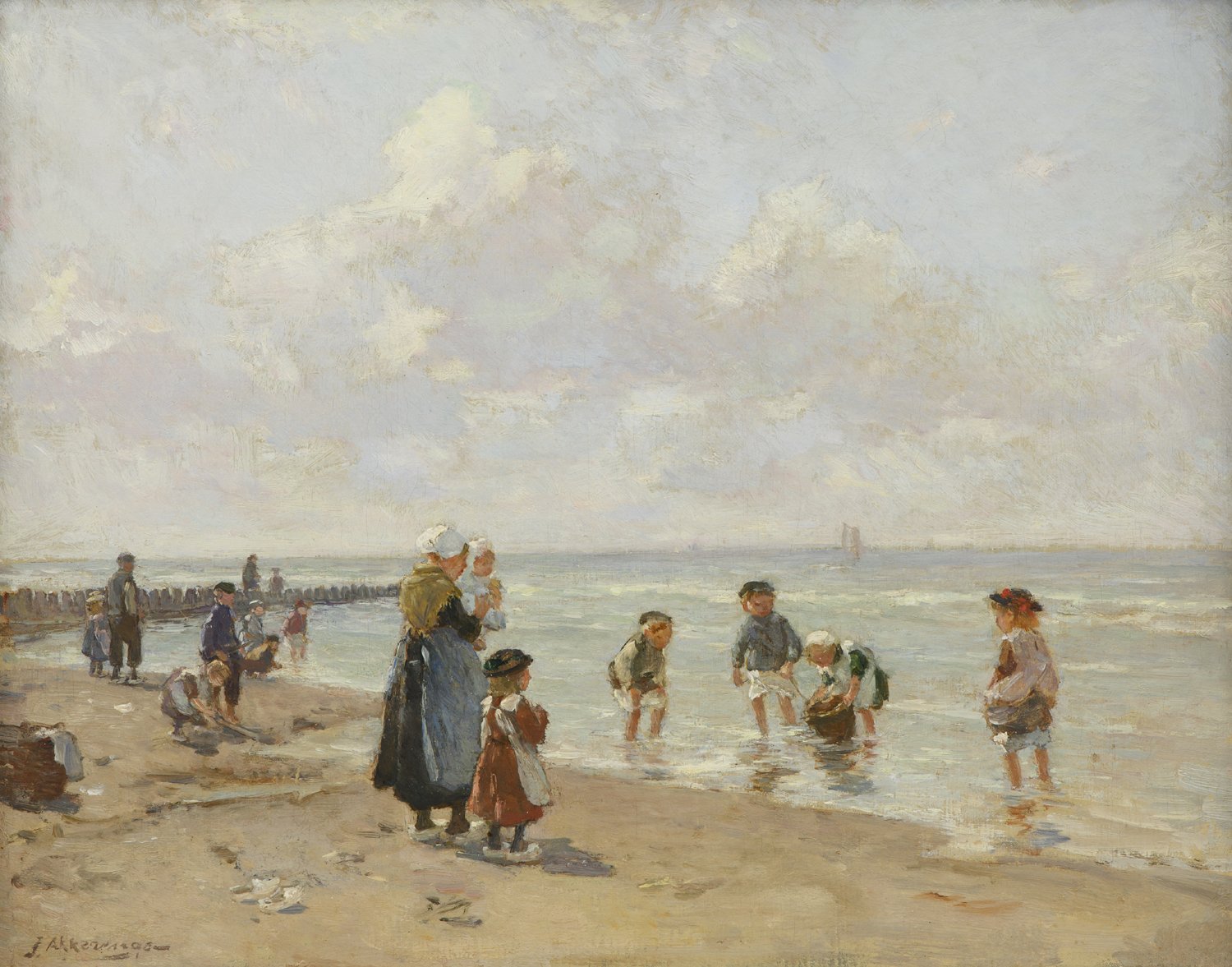
The painting was made on an oak panel with three white, oil-based preparation layers beneath the paint. It suffered extreme tenting and delamination, with separation occurring near the interface between the first preparation layer and the wooden support. More simply, the failure occurred very low in the structure, close to the painting’s foundation. Analysis identified a brownish, semi-translucent zone at the bottom of the first preparation layer. The authors interpreted this zone as an area where zinc white had been dissolved or altered by fatty acids from both the wooden panel and the oil binder. This matters because the affected zone was not a small isolated surface defect. It was located at a structurally critical boundary between the preparation layer and the support.
However, we need to acknowledge that the study did not present zinc oxide as the only cause of failure. The oak panel itself was also important as wood expands and contracts with changes in moisture, and the study proposed that the painting’s glazed framing system restricted the natural movement of the tangentially cut panel under fluctuating climatic conditions. This restraint, together with compression shrinkage, helped convert the weakened interface into visible tenting and delamination.
The case is therefore best understood as a coupled chemical-mechanical process. Zinc-related chemical alteration weakened or transformed a critical lower interface while mechanical forces acting through the constrained wooden panel then exploited that vulnerability, causing the paint and preparation layers to lift, tent, and separate. This case also does not prove that every zinc-containing painting will fail. Instead, it demonstrates how zinc-related chemistry can become highly consequential when it occurs in a very disadvantageous location: at a broad, structurally important interface. A small zinc-containing highlight on the surface would not carry the same system-wide risk as a zinc-altered preparation layer directly above the support.
The Akkeringa case also shows why all wooden panels should not be described simply as “rigid” and therefore safe. A panel may reduce canvas-like flexing, but wood is still a notably responsive material. It can expand, contract, and shrink, and it can generate stress when restrained. In this case, the support’s movement and restriction appear to have played a major role in turning chemical vulnerability into severe physical damage.
In plain terms, the lesson here is:
Zinc oxide did not act alone. It weakened a vulnerable lower layer, and the moving, restrained wooden panel pulled the weakened structure apart.
Why Manufacturers May Retain Zinc
Without direct statements from individual companies, inferences about manufacturer motives should not be treated as established facts. It is therefore important to distinguish between what can be documented and what is only technically plausible. However, several practical reasons may help explain why some manufacturers continue to use zinc oxide in certain oil colors.
One reason, as was presented early on in this writing, is that zinc oxide can contribute desirable optical and handling properties. Removing it may change a paint’s transparency, tinting strength, color temperature, body, rheology, mixing behavior, and drying characteristics. A titanium white containing a small amount of zinc oxide, for example, may not handle or mix exactly like a zinc-free titanium white.
Reformulation can also be technically difficult for a manufacturer. A zinc-free replacement may require adjustments to oil content, pigment volume, extenders, stabilizers, dispersants, tube consistency, drying behavior, opacity, and shelf stability. Changing one ingredient can alter the whole paint system. The resulting paint may behave differently from the product artists expect, even if the color name remains the same.
Different manufacturers may also have different risk tolerances. A company may judge a small amount of zinc oxide in a mixing white differently from zinc oxide used in a ground, materials often used in broad lower layers, or just a generally zinc-rich paint. That distinction is scientifically reasonable because, as we’ve often noted here, risk depends not only on the presence of zinc oxide but also on concentration, formulation, layer position, thickness, support, and environment. At the same time, no universal safe threshold has been established for every possible paint system.
The available evidence supports precaution more clearly than blanket reassurance. Zinc oxide can contribute to long-term chemical and mechanical problems in oil paint, but the research does not provide a single concentration that can be declared safe across all formulations, layer structures, and environments. For that reason, continued manufacturer use of zinc should not automatically be taken as proof of safety, just as reformulation away from zinc should not be taken as proof that every zinc-containing paint will fail.
What the Evidence Supports at a Glance:
| Claim | Current assessment |
| Zinc oxide can contribute to deterioration in oil paint | Strongly supported |
| Zinc participates in carboxylate chemistry within drying oil | Strongly supported |
| Zinc carboxylates occur in more than one chemical and physical state | Strongly supported |
| Zinc-containing films can become stiff, brittle, or low in strain tolerance | Strongly supported |
| Zinc-bearing products can be redistributed or concentrated locally | Supported in particular systems; exact mobile species and mechanisms require case-specific evidence |
| Zinc always causes visible failure | Unsupported |
| Every zinc-containing painting will delaminate | Unsupported |
| Historical survival proves zinc is safe | Unsupported |
| A small amount of zinc is always harmless | Not established; depends on formulation, location, and context |
| A universal safe threshold has been established | No universal threshold established |
| Zinc in grounds and broad lower layers is especially consequential | Strong consequence-based precaution; supported by structural logic and case evidence |
| Thin localized upper use is generally less consequential | Reasonable precautionary comparison, not proof of safety |
| Fat over lean prevents zinc-related deterioration | Unsupported |
| All titanium white contains zinc | False |
| Formulation, support, and environment affect outcomes | Strongly supported |
| All zinc-white formulations behave identically | False |
| A rigid support eliminates zinc-related risk | False; rigid supports reduce some movement but do not eliminate risk |
So What Has Changed Since 2022?
The most important change is not that zinc has been exonerated or newly condemned. The field has become more specific. Since the recent public debate intensified, research has increasingly clarified which zinc-containing states, formulations, and layer structures are most relevant to risk. In plain terms, the question has shifted in many contexts from:
“Is zinc oxide good or bad?”
to:
“What kind of zinc oxide, in what kind of paint, in what layer, under what conditions?”
Better Differentiation of Chemical States
A distinction that has become central is the difference between zinc coordinated within a polymeric ionomer network and more mobile, aggregated, or crystalline zinc-carboxylate phases. In plain terms: Not all “zinc soaps” are the same. Some zinc may be dispersed through the paint’s hardened oil network, while some may accumulate as more concentrated or crystalline deposits. These different forms may affect the paint in different ways.
Better Characterization of ZnO Pigments
Analytical surveys have demonstrated substantial variability among historical and modern zinc-white materials, including differences in morphology, particle size, manufacture, purity, and optical behavior. What this means is that “zinc white” is not one identical material. Different zinc whites can have different particle shapes, sizes, impurities, and surface properties. Two paints may both list zinc oxide, but they may not age in exactly the same way.
Greater Attention to Formulation
Oil type, pigment manufacture, pigment volume, oil-to-pigment ratio, extenders, metal stearates, waxes, and other commercial additives are increasingly treated as central variables rather than minor details. The whole recipe matters. Zinc oxide does not act alone. The oil, additives, pigment concentration, stabilizers, and fillers can all affect how the paint dries, ages, reacts with water, forms zinc soaps, or becomes brittle.
Better Spatial Analysis
Advanced chemical imaging methods can map compounds and degradation products at the microscopic and submicroscopic scales, helping researchers distinguish bulk-film chemistry from localized interfacial changes. Scientists continue to find better means to see more precisely where chemical changes are happening inside the paint. A problem that spreads throughout a whole layer is quite different from one concentrated at a boundary between layers.
More System-Level Interpretation
The strongest current models treat the painting as a coupled chemical-mechanical laminate rather than as an isolated pigment. A painting is like a layered structure, not just a pile of ingredients. Chemistry, layer order, adhesion, support movement, and environmental stress all interact. Zinc oxide may be only one part of the problem, but in the wrong layer or formulation it can become very important.
Practical Guidance for Painters
Recommendations ranked by confidence.
High-Confidence Precautions
- Avoid zinc oxide in oil grounds when long-term durability is a priority.
- Avoid zinc-rich broad underpaintings and foundational layers.
- Be especially cautious on stretched canvas and other flexible supports.
- Check labels and technical data for PW4, the pigment index code for zinc white/zinc oxide.
- Do not assume that a paint called Titanium White contains only PW6 (the pigment index code for titanium dioxide). Some titanium whites contain both PW6 and PW4.
- Retain labels, batch information, and formulation records when longevity matters.
- Do not treat the absence of visible damage as proof that no chemical or mechanical change has occurred.
Reasonable Precautions
- Prefer zinc-free titanium white for routine mixing where zinc’s special optical qualities are unnecessary.
- Where zinc’s translucency, cooler handling, or lower tinting strength is specifically desired, restrict it to localized, thin upper passages.
- Avoid thick zinc-rich impasto where long-term strain tolerance is important.
- Use dimensionally stable supports and sound preparation systems, while recognizing that no support eliminates zinc chemistry.
- Minimize repeated flexing, vibration, impact, and uncontrolled environmental fluctuation.
Claims That Cannot Yet Be Made Confidently
Current evidence does not establish:
- an exact safe percentage of zinc;
- a universally safe film thickness;
- a binder that eliminates zinc-related risk;
- a support that guarantees safety;
- a visual test that predicts future failure;
- a commercial formula that guarantees all zinc use is archival;
- a simple equivalence between tube percentage and long-term risk.
The Most Defensible Conclusion
Today (July 2026), Zinc white remains in use because it offers genuine artistic benefits. Its relatively low tinting strength, translucency, smooth handling, cool appearance, and ability to moderate the forcefulness of titanium white have all contributed to its historical importance and continued appeal. At the same time, zinc oxide is not chemically passive in drying oil. It has repeatedly been associated with zinc-carboxylate formation, changes in stiffness and brittleness, reduced strain tolerance, cracking, interfacial weakness, and delamination. These risks are not imaginary, but neither are they automatic.
The evidence does not justify saying that every use of zinc oxide will fail. It also does not justify saying that the survival of some zinc-containing paintings makes the warnings negligible. Historical survival data show that zinc-related failure is not inevitable; they do not prove that zinc oxide poses no elevated risk. The most accurate conclusion is this:
Zinc oxide is a conditional but credible conservation risk. The greatest concern arises when it is used extensively in grounds, broad lower layers, or other mechanically important parts of a painting, especially on flexible supports. Limited use in thin, localized upper passages represents a different and generally lower-consequence scenario, but no universal safe concentration, thickness, or formulation has been established.
As with so many materials at our disposal, an artist may knowingly accept a risk in exchange for a desired optical or handling property. The role of materials research is not to forbid that or any choice, but, as always, to ensure that our choices are appropriately informed.
Core References
Beerse, M., Keune, K., Iedema, P. D., Woutersen, S., & Hermans, J. J. (2020). Evolution of zinc carboxylate species in oil paint ionomers. ACS Applied Polymer Materials, 2(12), 5674–5685. https://doi.org/10.1021/acsapm.0c00979
Duivenvoorden, J. R., Caporaletti, F., Woutersen, S., Keune, K., & Hermans, J. J. (2023). Nanoconfined water clusters in zinc white oil paint. The Journal of Physical Chemistry C. https://doi.org/10.1021/acs.jpcc.3c04720
Hermans, J. J., Baij, L., Koenis, M., Keune, K., Iedema, P. D., & Woutersen, S. (2019). 2D-IR spectroscopy for oil paint conservation: Elucidating the water-sensitive structure of zinc carboxylate clusters in ionomers. Science Advances, 5(6), eaaw3592. https://doi.org/10.1126/sciadv.aaw3592
Izzo, F. C., Kratter, M., Nevin, A., & Zendri, E. (2021). A critical review on the analysis of metal soaps in oil paintings. ChemistryOpen, 10(9), 904–921.
Osmond, G. (2012). Zinc white: A review of zinc oxide pigment properties and implications for stability in oil-based paintings. AICCM Bulletin, 33(1), 20–29. https://doi.org/10.1179/bac.2012.33.1.004
Osmond, G. (2014). Zinc oxide-centered deterioration of modern artists’ oil paint and implications for the conservation of twentieth-century paintings [Doctoral thesis, The University of Queensland]. https://espace.library.uq.edu.au/view/UQ:347180
Osmond, G., Keune, K., & Boon, J. J. (2005). A study of zinc soap aggregates in a late 19th century painting by R. G. Rivers at the Queensland Art Gallery. AICCM Bulletin, 29(1), 37–46. https://doi.org/10.1179/bac.2005.29.1.004
Palladino, N., Occelli, M., Wallez, G., Coquinot, Y., Lemasson, Q., Pichon, L., Stankic, S., Etgens, V., & Salvant, J. (2024). An analytical survey of zinc white historical and modern artists’ materials. Heritage Science, 12. https://doi.org/10.1186/s40494-023-01082-4
Romano, C., Lam, T., Newsome, G. A., Taillon, J. A., Little, N., & Tsang, J.-S. (2020). Characterization of zinc carboxylates in an oil paint test panel. Studies in Conservation, 65(1), 14–27. https://doi.org/10.1080/00393630.2019.1666467
Case-Study and Conservation References
Jongstra, A., van den Berg, K. J., Hendriks, E., de Groot, S., van Keulen, H., & Stols-Witlox, M. (2020). “Breaking Waves”: The relationship between zinc oxide degradation and extreme delamination from the panel support of Beach Scene by J. E. H. Akkeringa (1861–1942). In K. J. van den Berg, I. Bonaduce, A. Burnstock, B. Ormsby, M. Scharff, L. Carlyle, G. Heydenreich, & K. Keune (Eds.), Conservation of modern oil paintings (pp. 289–296). Springer. https://doi.org/10.1007/978-3-030-19254-9_22
Pratali, E. (2013). Zinc oxide grounds in 19th- and 20th-century oil paintings and their role in picture degradation processes: A literary review, paint failure mechanisms, and conditions of potential risk. CeROArt.
Manufacturer and Artist-Facing Sources
Sands, S. (2018, February 21). Zinc oxide—Reviewing the research. Just Paint. GOLDEN Artist Colors.
Gamblin Artists Colors. (n.d.). Zinc oxide in artists’ oil colors. Gamblin Artists Colors.
Michael Harding Artists Oil Colors. (2018). Statement concerning the phasing out of Zinc White and the removal of zinc oxide from selected mixed colors
What an incredibly well reasoned and researched article. Thank you for bringing some clarity to the current assessment of using zinc white.
Thank you Connell. 🙂